Hearty Lunch

We reached the village of Lao Chai, which was more than half way of our trek from the town of Sapa, Vietnam. Our guide May told us that we would stop here for a lunch break. The trek so far had been mostly downhill, and the weather was cool enough that we didn’t sweat that much. But a break was definitely welcomed by then.

We crossed a wooden bridge that swayed a little bit as we walked across it. The place where we stopped for lunch was just after the bridge. It seemed to be a multi-story structure that stood on the cliff with the top floor set up to be a dining area, and the bottom part seemed to be where the kitchen was located and also possibly where some of the local hosts lived. While it’s set up like a restaurant, I think they mainly catered the trekking groups that passed that route. I didn’t see any sign for a restaurant or any menu given.

After we were seated, May explained that we had a couple of choices for lunch, either noodle soup with vegetable and fried eggs, or noodle soup with chicken meat. The food was part of the trekking arrangement, but the drink wasn’t. So we got to choose also whether to get bottled water or canned soft drinks. Everyone in our group asked for the noodle soup with vegetable and fried eggs.

There were several other trekking groups who were eating at the same time, so they were quite busy preparing the food for us. May helped out in serving the food and drink. The meal itself ended up to be nothing special; it looked like they prepared instant noodles as the base, but added vegetables and fried eggs as toppings. This reminded me to some places in Jakarta where you could get cheap meals on the side street where it’s basically just instant noodles but with added toppings like vegetables and eggs. I think in the end it didn’t matter as much as we were quite hungry by then, and I think we valued more the atmosphere and the people who we were with, as well as the generosity and hospitality of our hosts in serving us. I don’t think May had anything to eat as she was busy helping the hosts serving, but she was still smiling and cheerful even after we’re done with our lunch and ready to continue with our trek.

The photo below was taken from the bridge as we saw the place where we’re about to have lunch. You can see a couple of these places, with the area on their top floors where they set up the dining areas.

Lunch spot

Trekking Path

Sometimes when you go on a trip what you had in mind when planning for it and what you actually experience could be very different. When we planned for the trek to the villages around Sapa, Vietnam, the picture I had in mind was what I saw on photos and on a Travel Channel program about going there: mountains, and green, terraced rice fields with farmers and their buffaloes plowing the field. Well, during our trek to Lao Chai and Tavan villages, we did see those, but the path and the experience was nothing like what I imagined in my mind.

First off, we came during the winter time, so during that time of the year apparently it rains a lot in the area, and there are many days where visibility was close to zero due to thick fog. That’s definitely not the picture I had in mind especially when coming there with photography as one of my objectives. During our hike, it drizzled a little but there were residues of the previous day’s rain, so you have puddles and muddy stretches on the path everywhere. 5-10 minutes into the trek, we pretty much didn’t care anymore about getting our shoes and pants dirty with mud.

It wasn’t completely foggy, but it was definitely cloudy and the fog was there in some areas. So the photos I got were not washed out due to harsh lighting, but at the same time it had the sense of cool, mysterious, place.

At one stretch of the hike we finally saw the terraced rice fields, but they were so far down in the valley that the view was more like a bird’s eye view of the area. And since it was winter time, the fields were mostly brown (not green) as it’s not close to harvest time.

As I mentioned in the previous post, we were also accompanied by an ‘entourage’ of local women who tried to sell their handicrafts to us. Also, since we went through a pretty popular trekking route, there were areas where we ended up in a long traffic as there were other groups of hikers in front of and behind us (with their own set of ‘entourage’).

All in all, it was very different than what I had in mind, but it was interesting experience nevertheless.

The photo below was taken during such ‘log jam’; you can see the people in front of us going down the path to the bottom of the valley. From the clothings, you could tell the difference between the tourists and the local ‘entourage.’

Trekking path

Great Husband

As we went down through the muddy and steep path towards the villages outside Sapa, Vietnam, our guide May led the way and stopped frequently to let the group catch up with her and ensure we’re okay during the hike down. We’re not used to going through this path, so it took us a bit longer than her or the local ladies that walked with us.

Dave and Anna were walking in front of me. Dave went first to follow the foot steps of May, then he stopped and helped his wife Anna to walk through the same steps. May and the local ladies observed this, and they seemed to be very impressed with what Dave did. At one point, May said, ‘Dave, you’re a great husband. Vietnamese men don’t do that to their wives.’

I thought that was interesting to notice how different cultures treat the interaction between man and woman differently. In the western culture, there is the idea of courtesy and being a gentleman where as a good manner men are supposed to let women to go first, open the door for them, or help them going through difficult path like what Dave did. It’s especially emphasized when you’re with someone you care about (your significant other, family, friends, etc.) or simply just as an etiquette. I think one should extend this behavior to beyond the people you care about, and treat others — even strangers — with respect as well. It’s a breath of fresh air to see that kind of behavior in a culture that sadly is going towards a more selfish one, and where people do such acts of courtesy as something done potentially to getting something back in return in mind.

In Vietnam, similar to some other Asian cultures, the idea of courtesy is there, but typically it’s towards the elderly or those with higher rank. It’s not so much taught or practiced when you have someone else at the same age. When Kristi and I were in Hanoi, we actually experienced an example of ‘no courtesy.’ We were waiting in line to get tickets to enter the Ho Chi Minh Museum, where a couple of times we had others (Vietnamese) cut in front of us even though they saw we were waiting in line. One of them even looked at us and smiled before leaving. With regards to man and woman, typically the man is the head of the house and the woman is expected to follow, obey, and serve. It sounds bad, but I’m sure there are many men who love their wives and would do anything for them. But it’s just not a familiar idea I suppose to have the men yielding to the women or helping them in day-to-day activities.

Having lived in both cultures, in the end I think again the idea of being courteous and respecting others go beyond just towards the women or towards the people we care or respect. I think in daily lives, it’s always important to respect others, regardless of gender, age, national origin, titles, or any other cultural division among people. And this goes to any situation and anywhere you go.

I captured the moment below as Dave was helping Anna to step through the muddy path going down to the valley. May was trotting through the path like a ‘mountain goat’ in the front, and on the side you can see a couple of the local ladies watching Dave helping Anna.

Courtesy

Mountain Goat

As we were about to start our hike down the valley to the villages outside Sapa, Vietnam, our guide May told us to be careful and take our time during the hike down. She said, ‘The ladies here and I grew up here, so we are used to taking this path. We’re like mountain goats — we can jump around and go down the path pretty easily. A lot of the foreign visitors are not used to that, so be careful and take your time, we don’t want any accident to happen.’ After she said that, I looked down the path we’re about to take. It started with a muddy, narrow path, but quickly becoming more challenging as it started sloping down.

I looked at my fellow travelers. I don’t think any of us were expecting this, but we thought we’ve gone this far, and if these local ladies could take this path (even with basket full of handicrafts on their back), we surely should be able to follow them. We all wore hiking boots, compared to May who wore a pair of canvas shoes that looked like Converse shoes and some other local ladies wearing rubber boots. But quickly I realized that it’s not about the equipment that would help you go through this terrain, it’s more the experience of going through it, knowing where to step that’s safe. May gave Kristi a long stick that she said could be helpful as we hiked down. Dave helped his wife Anna as they followed May’s footsteps. I spent the next few minutes doing the same thing, keeping my eyes looking down and following exactly where May, Dave, and Anna went.

Looking back, I thought it was interesting to compare this path to the hiking trails that occasionally I went through at the Shenandoah National Park near where I live in the United States. At Shenandoah, even the so called ‘strenuous’ hiking trails are typically well maintained, with signage, and even in many places well-placed stepping stones or rails to help the hikers to go through the terrain. In Sapa, the path seemed to be one that probably started as an animal path, or one that someone discovered as a good route to go between places. No one really spent time to maintain the path. In the US, the trail was mostly for recreational use (well-off country like the United States would have funding to preserve lands as National Parks). In Sapa, this was a path that’s used by the locals on daily basis as they go from their village to the town. We as tourists were doing this trek for fun. The locals take this trek as part of their day-to-day life.

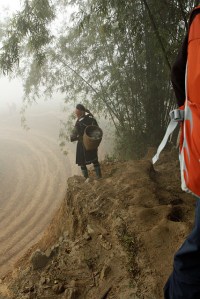
On the photo below you see the beginning of our hiking path. Notice the muddy path, the local girl in front of us with the basket on her back, and what looked like a steep drop in front of her.

Muddy path

Trail Head

After witnessing the motorcycle accident at the beginning of our trek to the villages outside Sapa, Vietnam, we continued our walk and before long we reached a side road that looked like the beginning of a trail head down the valley. The road turned from asphalt to gravel, and then it ended at a point where we saw a large group of local women standing around. We had a couple of local women walking with us from Sapa — they were trying to connect with Anna and Kristi and convincing them to purchase the handicrafts, and even after Anna said no, they still continued to follow us.

There were at least 20 of other local women standing at the trail head. It seemed that they knew the tourists would come through that route, so they waited there for the groups to arrive. As they saw us coming, some of the women stopping talking with their friends and started joining our group. So the group that started with five people (our tour guide May, Dave, Anna, Kristi, and me) had more than doubled when adding the local women who went with us.

Anna asked May if this was normal to have such an ‘entourage’ going with the groups, and she said yes. Many of these women came from the nearby villages and compared to the majority in Vietnam, they were quite poor economically. The handicraft business was their way to try to capitalize on the foreign visitor interests in their culture.

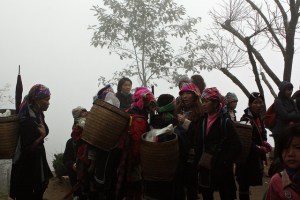
The photo below was taken as we reached the trail head. You can see the gorup of women waiting for the hikers to arrive.

Waiting for tourists