School Performance

After we finished our lunch in the village of Lao Chai, we continued our trek to the village of Tavan, which was located about 3 km away from Lao Chai, also in the valley near Sapa, Vietnam. The walk between the two villages was pretty flat; we spent the time chatting with our guide May talking about her life experience living in the nearby village and about the local culture.

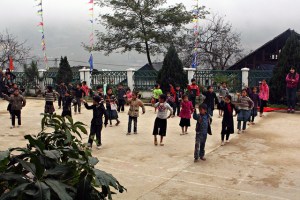
When we arrived in Tavan, we stopped at a local elementary school, where at the schoolyard there was a dance performance by the students shown for the tourists who came to visit. It was pretty cute to see these little kids — mostly between 5 and 8 years old, performing the coreographed dance to the tune of music playing on a boombox. Their teacher was watching them performing. Many of the tourists including myself got closer to the performing kids so we could take photos of them during the performance.

We stayed there for a little bit to watch the performance, then continued our trek. One thing interesting however was May’s comments to us as we left the school. She said that the school was opened by the Vietnamese government to educate the local children, mostly from the minority tribes (you could tell the government influence as there was a picture of Ho Chi Minh prominently on display at the front of the school). While undoubtedly the children received education, with the increasing popularity of tourism coming to the area, now the teachers tried to charm the visitors with the performances by the children to encourage the visitors to give donation to the school to help the poor children. This is well intentioned, but at times there are occasions when it seemed that in some schools the money donated never actually made it to the children, but instead were taken by the teachers. When you have teachers in remote area like this with likely pretty low salary, it’s not surprising that such corruption may happen. A better way to donate to the local community was by bringing in some school supplies that the students could use.

The photo below was taken during the performance by the school children. You can see them performing while their teacher was watching on the side, and the tourists were watching from the background.
School performance

Hearty Lunch

We reached the village of Lao Chai, which was more than half way of our trek from the town of Sapa, Vietnam. Our guide May told us that we would stop here for a lunch break. The trek so far had been mostly downhill, and the weather was cool enough that we didn’t sweat that much. But a break was definitely welcomed by then.

We crossed a wooden bridge that swayed a little bit as we walked across it. The place where we stopped for lunch was just after the bridge. It seemed to be a multi-story structure that stood on the cliff with the top floor set up to be a dining area, and the bottom part seemed to be where the kitchen was located and also possibly where some of the local hosts lived. While it’s set up like a restaurant, I think they mainly catered the trekking groups that passed that route. I didn’t see any sign for a restaurant or any menu given.

After we were seated, May explained that we had a couple of choices for lunch, either noodle soup with vegetable and fried eggs, or noodle soup with chicken meat. The food was part of the trekking arrangement, but the drink wasn’t. So we got to choose also whether to get bottled water or canned soft drinks. Everyone in our group asked for the noodle soup with vegetable and fried eggs.

There were several other trekking groups who were eating at the same time, so they were quite busy preparing the food for us. May helped out in serving the food and drink. The meal itself ended up to be nothing special; it looked like they prepared instant noodles as the base, but added vegetables and fried eggs as toppings. This reminded me to some places in Jakarta where you could get cheap meals on the side street where it’s basically just instant noodles but with added toppings like vegetables and eggs. I think in the end it didn’t matter as much as we were quite hungry by then, and I think we valued more the atmosphere and the people who we were with, as well as the generosity and hospitality of our hosts in serving us. I don’t think May had anything to eat as she was busy helping the hosts serving, but she was still smiling and cheerful even after we’re done with our lunch and ready to continue with our trek.

The photo below was taken from the bridge as we saw the place where we’re about to have lunch. You can see a couple of these places, with the area on their top floors where they set up the dining areas.

Lunch spot

Free Range Chicken

We finally reached the village of Lao Chai as we hiked down to the valley near Sapa, Vietnam. We walked on the dirt road that cut through the village. On the side of the road, we saw more terraced rice fields and some homes. We also saw something that’s probably common to see in the villages in Southeast Asian countries, but not in the United States or other western countries, animals roaming around near the homes: dogs, chickens, and pigs. Seeing dogs roaming around as pets are not unusual. But seeing chickens and pigs, those are a little different. They pretty much roamed around freely, not just in an enclosed, grassy areas, but really just anywhere around the homes, and some even roamed outside to the dirt road.

The first thought that came to my mind was that this gave a new meaning to ‘free range.’ In the United States, there were concerns about how farm animals are treated. Many farms were focusing on increasing the production of meats and poultry that the way the animals were grown some considered as ‘inhumane’ or cruel. The animals were caged and lived unnaturally. So the industry then tried to improve this by introducing the idea of having ‘organic’ and ‘free range’ animals. The animals were fed more natural foods (without chemicals or growth hormones) and instead of caged, they were free to roam on the field. The result was supposedly not only more humane treatment for the animals, but also healthier and better tasting meats.

I thought of that concept in comparison to how locals grow animals in Vietnam. The locals in the villages have some pig and chicken, but they’re not necessarily farmed for high volume production. According our guide May, the locals eat meat, but that’s considered as luxury and they only have those for special occasions. So no one cares really about the idea of ‘organic’ or ‘free range.’ They would probably look at you funny if you talked about treating the animals in ‘humane’ way. Animals don’t get treated in any special way, but they are also valued so it’s likely they don’t get treated in any bad way either. I remembered a story from my father who lived in a poor village in Indonesia when he was young — having eggs as special meal for a birthday as those were too expensive to get for day-to-day consumption. That makes me feel grateful of the blessings we have today — in many cases it seems that if anything we need to reduce the consumption as the excess can be detremental to our health.

The photo below was taken from the dirt road as we walked into the village. You can see the chickens just roamed around on what looked like a pretty dirty grounds.

Terraced rice fields

Terraced Rice Fields

As we continued our descent to the valley near Sapa, Vietnam, we saw that we closely approached where the some of the terraced rice fields were located. So far we had been following a muddy path down. Then as I looked at where that path led to at the bottom of the descent, it looked like it ended at a small stream that we would have to cross. On the other side of the stream, I couldn’t see any continuing path. Instead there were the terraced rice fields.

We watched the group in front of us going through there, and it became clear that once you cross the stream, you would then walk on the narrow pathway in between the rice fields (what looked like the boundary or outline of the terraced rice fields when you see them from far away). It didn’t look too bad from far away, but when you get closer, it looked like an interesting exercise walking through that stretch while staying in line within your group. The challenge was that you need to maintain your balance on the narrow path, and on one side it plunged down to the stream below, and on the other side you have the muddy rice fields.

When it came to our turn going down there, I walked carefully crossing the stream to make sure I hopped from rock to rock and not getting wet from plunging to the stream. That was not too bad. But then as we walked on the narrow pathway next to the rice fields, at one point I lost my balance a little bit, and ended up with one foot in the muddy rice field — my whole hiking boot turned brown covered with mud. So much for trying to keep my boots clean… At least it wasn’t as bad as going to the other side and falling into the stream. We continued on our trek as if nothing happened. Fortunately it wasn’t too far until we reached an actual road / path again.

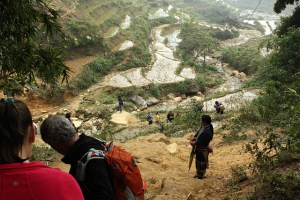
The photo below was taken before we descent through the last segment before we reached the bottom of the valley. You can see here May was already a bit in front of us and waited for Dave and Anna in front of me to start descending. At the bottom of the descending path, you can see the little stream and the terraced rice fields on the other side.

Terraced rice fields

Local Kids

As we continued our descend to the valley on the way to the villages near Sapa, Vietnam, we reached an area where there was a logjam of many hikers with their guide and local women entourage trying to go through a narrow and steep descending path. It was getting uncomfortable stopping and waiting on the incline, though finally there was a flat area with a couple of houses where we could take a break before continuing the descent.

At this area, there was a local lady opening up a little shop selling souvenirs and handicrafts. She also had some bottled and canned drinks — a welcome sight for many of the hikers who by then had gone through at least about an hour or two into their trek. No one from my group went for those, however. We just stayed there for few minutes waiting for the group in front of us to walk through the path. While waiting, I noticed a group of several local kids, mostly under five years old, hanging out and sitting near the souvenir stand. I guess the kids came there with their mothers who were selling souvenirs, or they probably live nearby? In any case, it was interesting to see these little kids at a spot in the middle of a steep trail between the main road to Sapa and the village in the valley. I wondered how they got there… either they came with their parents, or somehow they made it there on their own through the rough terrain that made us the visitors who came with our fancy hiking gears looked like rookies when it comes to navigating through there. I also wondered what these kids think of the strange-looking people going through their ‘neighborhood’ every day; I suppose they’re used to seeing foreign tourists after a while.

The photo below was taken while we’re waiting in that area and when I observed these local kids hanging around there watching the tourist traffic passing by.

Local kids