Jim Thompson House

After our whole day full of activities in Bangkok, on the following day we had the morning time to do one last activity before we have to head to the airport to continue our journey. We decided to visit the Jim Thompson’s House Museum, which was easily reachable from our hotel by SkyTrain.

Jim Thompson was an American ex-pat who came to Thailand when he worked for the CIA. He ended up staying in Thailand and building a business empire selling Thai silk products. In the early 1960s, when he was in Malaysia for vacation, he disappeared and was never found. Today his house in Bangkok is a museum as a tribute to his life and his art collection.

The visit to the Jim Thompson House included a tour of the interior of his house. We were not allowed to take photos inside, but it was interesting to learn about some traditional features of Thai homes that were incorporated into the house. Things like having the home elevated to deal with possibility of flooding, and having a board to cover the bottom part of an entrance — believed to help prevent bad spirits to enter the home because there is a belief that the spirits travel on the floor surface. The home was a nice, cool oasis from the hot and humid day in Bangkok. It was not air-conditioned but it had very nice air flow throughout the house. It reminded me to some old homes in Indonesia.

Another interesting aspect that was similar to tradition in Indonesia was the rule to take off our footwear before entering the home. The Thai believes in keeping the house clean, so we were supposed to leave the dirty/dusty footwear outside and enter the house barefooted. It was interesting that within our tour group there were a couple of westerners who apparently didn’t feel comfortable with that rule, and they decided to just forego the tour and left.

The photo below was taken at from the gravel entry way outside the home. This is where visitors wait for their house tour to start.

Jim Thompson House

Sanam Luang

Sanam Luang or the Royal Field is a large area not far from the Grand Palace in downtown Bangkok, Thailand. This large field has a long history. Starting during the reign of King Rama I in the 1780s, the field was the site of important royal events and ceremonies, specifically royal cremations. Starting the early 20th century, the area was opened as a public park. Throughout the years, it was used as the site for festivals, public recreational activities, and even more recently the site for demonstration against the ruling government. At night, the area served as temporary shelter for homeless people, and there were also big flea market operating in the area.

During our night bike tour with the Grasshopper Adventures, we passed Sanam Luang area on our way back towards the Grasshopper Adventures office from our last stop at Wat Pho. It was interesting riding on the bike and seeing on the grass fields many people lying on mats. It was kind of peculiar — seemed like you had people relaxing at the park, but at night. Later on I found out that these folks were likely homeless; they work during the day elsewhere in the city, but they didn’t have a place to stay at night, so they stayed at Sanam Luang because it was lighted and there were other people, so it’s somewhat a ‘safe’ place to be. And then not far after passing that area, we found ourselves riding on sidewalk that kept narrowing because there were flea market vendors setting up their display on both sides of the sidewalk, and with many people walking around checking out the display, we had to be very careful riding our bike through there (at one point one of our bikers fell onto a vendor’s display mat; I wasn’t sure if there was any damage on the goods that the vendor was selling, but fortunately it didn’t cause any big problem). Now looking back I thought it’s interesting to compare that to the National Mall area in downtown Washington, DC. They’re kind of alike, though I don’t think we see as many homeless people in the National Mall area (you could see some of them at other public parks in DC), and there is no flea market there. As I googled around before writing this blog post, I saw a couple of articles about Sanam Luang saying that in early 2011 the area was closed and cleaned up, and now it’s illegal to stay overnight, stage demonstration, or sell stuff in the area. So it’s back to its previous beautiful state, but I guess it’s not as culturally interesting as it was in the last few decades.

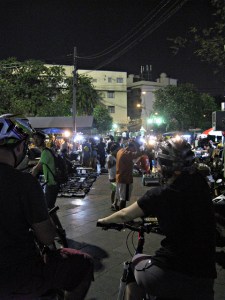
I took the photo below from my bike as we rode through the flea market. There was a little ‘traffic jam’ and we were stuck for few minutes at this location, allowing me to take a quick snapshot capturing the atmosphere there that night.

Sanam Luang Flea Market

Wat Pho at Night

Sometimes you can go to the same place during the day and at night and get different perspectives or experience different atmospheres. Such was our visit to Wat Pho during our full day in Bangkok, Thailand. We visited Wat Pho in the morning when it was open for the public, and the temple complex was quite full with visitors and worshippers alike. The complex also hosts a school teaching traditional Thai massage, so you have students and guests for the school on the grounds as well. As mentioned in a previous post, we even met scammers who tried to get us diverted to take tours elsewhere.

That night we came back to Wat Pho as part of our night bike tour with the Grasshopper Adventures. This time around it felt like we’re visiting a different place. At night the temple was closed to public, the building where the large statue of the Reclining Buddha was also closed, and the only people around were night guards. The Grasshopper Adventures obtained special permission for our group to stop at the temple grounds and walk around inside for about half an hour or so with our guide. The buildings were illuminated, but otherwise everything was quite dark. We had to resort to our little LED headlights and followed Tami who also brought a flashlight with her. It was pretty cool to go around the grounds with the whole place for ourselves, and in some areas, with complete darkness and only Tami’s flashlight and our headlights lighting the path or portions of the wall, it felt like we were inside some ancient temple during an archaeological expedition. Totally different feeling compared to our visit earlier during the day, when most of the time we had to contend with the crowd in looking at some of the more popular features of the temple, and during the hot sunny day looked for shaded area to cool down.

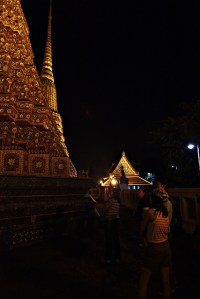
The photo below was taken while we were checking out the large stupas inside the Wat Pho grounds. You can see our group at the bottom of the ornate stupa that was illuminated at night.

Wat Pho at Night

Pak Khlong Market

Pak Khlong Market is a market in downtown Bangkok, Thailand, that is the primary flower market in the city. Located near the Chao Phraya River and the Memorial Bridge, this market had its history all the way to the reign of King Rama I (1782-1809). It started as a floating market, then later it turned into a fish market, and for the last 60 years it’s been a produce market (flower, fruits, vegetables). The market is open 24 hours a day, though it is busiest around dawn when the fresh shipment of produce arrives from other provinces of Thailand. The market serves mostly wholesale customers, though it also serves direct customers as well.

We visited the Pak Khlong Market during our night bike tour with the Grasshopper Adventures after we’re done riding through Thonburi and crossed the Chao Phraya River on the Memorial Bridge. We spent some time walking through the busy market, observing the various colors of flowers and smelling the fragrance. We also stopped at a couple of street vendors to taste fresh fruits and some local snacks. I think for photographers this is a fun place to visit as you get to see the various colors of flowers on display and the activities of vendors preparing bouquets of flowers and people looking to buy those.

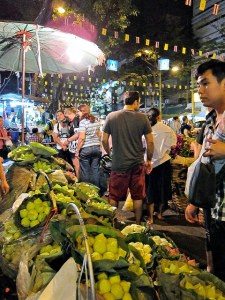
The photo below was taken as we walked around the market to observe the variety of flower arrangements being sold. You can see my fellow tourists were quite fascinated with what they’re seeing around.

Pak Khlong Flower Market

Wat Arun

Wat Arun is a temple located in Thonburi area on the west bank of the Chao Phraya River. The temple was named after Aruna, the Indian God of Dawn, because the first light of morning reflects off the surface of the temple and making it glow. The temple has been there since more than 300 years ago. During the time when Thonburi was the capital of the Thonburi Kingdom, the palace was located on the grounds of Wat Arun. It was the home for the Emerald Buddha statue until the capital was moved across the river to present day Bangkok and the Grand Palace in Bangkok was built. Today Wat Arun is one of the most recognizable landmarks in Bangkok as it can be seen prominently from the river.

During the night bike tour with the Grasshopper Adventures, we stopped at Wat Arun while riding in Thonburi area. The temple was closed at night, so we could only observe the architecture from outside. At night the temple was illuminated, so it still looked quite impressive. I thought it was interesting however, that the temple was located in a residential neighborhood, and there were many local residents hanging out around the temple. While we stopped and listened to our tour guide Tami telling us about the history of the temple, there were many local kids (5-10 year olds) playing around near us — some with their little bicycles even rode around with our group for a little bit. Many people were at the temple preparing floats and flower arrangements; apparently the following day was King Taksin’s birthday, so they were preparing for a ceremony to commemorate that. King Taksin was the Thai King when the capital was in Thonburi, and he was one who set up the royal palace near Wat Arun.

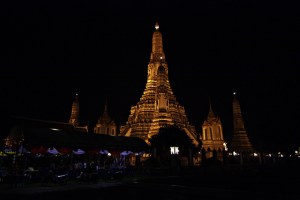
The photo below was taken from outside the temple. You can see the recognizable spires of the temple, and the area on the left was where the preparation for King Taksin’s birthday ceremony was taken place.

Wat Arun