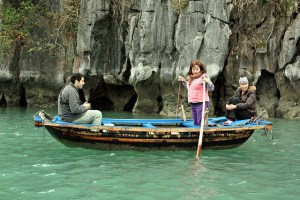
Boat Ride through the Village

From our boat, we slowly moved towards the Cong Dam floating village. We had several row boats; each boat had two passengers and was driven by a local lady from the village. We moved slowly and in a close cluster so we could hear our guide Smiley occasionally told us about something to note.

As we get closer to the village, Smiley told us to wear the hat given by our boat rower. I wasn’t sure the reason why, if it was part of protocol or simply just to help protect us from getting wet as it started drizzling, but we went ahead and followed the direction.

As we rode our boats slowly through the village and observed the life that’s going on in the village, I couldn’t help not to compare what I saw here to what we saw in the Chong Kneas floating village on Tonle Sap Lake in Cambodia few days before.

The two floating villages were roughly the same size; Cong Dam might’ve been a little smaller than Chong Kneas. People in both villages lived from fishing, Chong Kneas lived off fresh water fish from the largest lake in Southeast Asia, while Cong Dam had salt water fish from Ha Long Bay. Both started to benefit more from tourism, with Cong Dam having the advantage of being in a very beautiful natural setting of Ha Long Bay. Another big difference was that the people in Ha Long Bay have been there for a long time, while those in Chong Kneas were essentially illegal immigrants from Vietnam who have to compete with the locals.

In either case, I wonder what they think of the tourists who come and visit their village. I would compare that to a situation if somehow the neighborhood where I’ve lived for a long time suddenly becoming a tourist attraction. For some, it might be annoying, while others might welcome that for its potential economic benefits.

I took the photo below as we’re about to approach the village. You can see our boats and the village just in front of us.
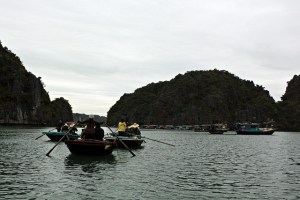
Boat ride through village

Siblings Trip

Del and Jerry are siblings from the United States who were in our Ha Long Bay tour group. They were at the end of their two-week long trip in Vietnam visiting Ho Chi Minh City, Hanoi, and Ha Long Bay.

Del was a pediatric surgeon who also taught at a medical school and gave workshops in many developing countries, so she traveled frequently. She had been to Vietnam before for work, but this time she wanted to travel for leisure with her brother. Jerry was a geography professor. He didn’t travel as much as his sister, but being in the geography field he knew quite a bit about places including Vietnam.

During the trip we shared the dining table with them during the meals, so we had some good conversations with them. It seemed that they had a nice time to spend with each other during this trip, perhaps a rare opportunity given their hectic professional schedules.

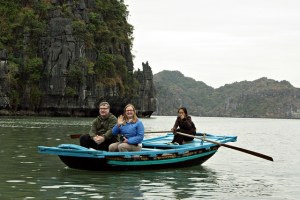
Here was Del and Jerry on their row boat during our visit to the Cong Dam floating village.

Del and Jerry

Homecoming

One of the most vocal and lively members of our Ha Long Bay tour group was a lady named Mrs. Hoa. She’s a Vietnamese lady who married an American and then lived in Idaho, USA. She came with her son, two daughters, and their husbands. She was originally from Hoi An area in Vietnam, but in this trip she also wanted to visit many other areas in Vietnam.

It was interesting to observe her and her entourage during the trip. She was very outgoing and pretty much spoke her mind whenever she saw or experienced something. In many cases it provided somewhat a funny interaction, especially when she had conversations and joked around with our guide Smiley who also had quite an outgoing personality. The other interesting interaction was with her son-in-law David, who had his Canon DSLR camera and took photos of everything he found interesting, kind of like the stereotype of Japanese tourists with cameras.

I thought it must be nice for her to be able to come back to her home country, accompanied by her grown up children and in-laws and to be able to share with them the experience that they might not have before back home in the United States. It’s also not something that most Vietnamese immigrants elsewhere could do; I know of many Vietnamese in the United States who had never been able to come back home since they left their home country decades ago.

I took the photo below from our boat as we passed Mrs. Hoa and David’s boat. Here was Mrs. Hoa trying to row the boat, and her son-in-law taking the photos of this interesting moment.

Mrs. Hoa

Row Boats

After Smiley finished with his overview of the floating village, he told us to meet back in the lower deck in a few minutes to leave for the floating village visit. He didn’t tell us how we would be getting to the village; I presumed it would be on a tender like how we got to the junk boat from the pier.

Kristi and I went back to our room for a few minutes. While we were in our room, we saw through our window an interesting sight: several small row boats coming from the village direction towards our boat. What made it even more curious, as they got closer we noticed that all of the rowers were women.

Smiley told us to board a row boat in pairs; it worked out pretty well as we had even number of people in our group. After all of us got on board on the row boats, we slowly moved away from our junk boat and went towards the village.

What I learned later on was that these women were from the village we were about to visit. Their husbands worked as fishermen during the day, so we didn’t see them around. The Indochina Junk company hired them to row the boats for the guests and this provided some extra income for the families in the village.

I felt a bit uneasy being on a boat and having a lady rowing it. But the more I thought about it, she probably had done this all her life and was able to do it quite effortlessly, at least compared to someone like me who had never done that before.

The photo below was taken from the top deck shortly after we noticed the boats coming and before we boarded on to the boats.

Row boats

Responsible Tourism

Just before we were ready to go to visit a floating village in Ha Long Bay, Vietnam, we gathered on the upper deck of our junk boat to get an overview about the floating village and the life there. Our guide Smiley started with mentioning a little bit about some of the background information that built upon some information I already learned from reading some materials that were provided as part of our cruise. But towards the middle of his presentation, Smiley talked about the unfortunate negative impact of human settlement and now increase of tourism on the nature. Quite unexpected to hear especially in a developing country especially when the tourism industry was booming in the area.

Smiley said that as the number of tourists increased, inevitably there was impact to the nature as pollution increased, rubbish produced and polluted the environment, and the traditional lives of the locals impacted with the constant visits of guests. In many cases, others looked to profit from such increased in popularity and demand for tourism, but neglected how their actions impact the actual nature that drew the visitors to come in the first place. He said the Indochina Junk, the company that owned and operated the Dragon’s Pearl and several other boats, was working with the local government to launch a program called ‘For a Green Ha Long Bay’ which aimed at educating the locals and the tour operators to help reduce the negative impact tourism has on the nature and the lives of the locals. They helped with rubbish collection, and also educated and provided more environmentally friendly materials to use in the floating homes. He also mentioned that parts of the proceeds from our tour actually went to the village that we’re visiting.

When I heard this presentation, while on one hand I was happy to hear that we seemed to go with a tour company that was environmentally responsible, on the other hand I was wondering how sincere that was, or whether this was all just a presentation to the foreign tourists so they feel good about themselves, and potentially help market and recommend the company to other tourists. I hate to be that cynical, but I guess unless I see more visible activities (e.g., perhaps also offering a more voluntourism type trips where guests can also participate in activities that help improve the locals), it remains to be seen whether that’s all just a show or it really is because they want to be ethically responsible.

I took the photo below while Smiley was giving his presentation to our group. You can see the village we’re about to visit in the background.

Responsible tourism presentation