Cultural Harmony

When we walked around the Chinatown neighborhood in Singapore, two of the buildings we passed were among the oldest in the neighborhood and stood out from their surroundings. In the middle of a concentration of Chinese community, there were two houses of worships, a mosque and a Hindu temple, that normally you wouldn’t associate with the Chinese.

Both places are considered as national historic landmark, and appropriately so as they reflect the history and cultural diversity of Singapore as a result of being a port city influenced by immigrants and traders. Masjid Jamae was built in 1820s by the Chulias, Tamil muslims who came to Singapore as traders and money changers at the nearby port. It was among the oldest mosques in Singapore. Not far from there, there is the Sri Mariamman Hindu temple, which was built around the same time for the Hindu South Indian immigrants in the area. Both places are still in use today as house of worship.

One of the reasons why Singapore is a popular destination in Asia is because it is a place where one can experience many cultures meeting in one place and influencing the life there — it’s an Asian cultural melting pot. I think during our short walk in the Chinatown area we got a taste of that; seeing the mix of the different cultures, and also seeing a neighborhood with old buildings preserved with skyscrapers in the backdrop. That’s a great image that represents Singapore as a whole, a mix of many cultures and the old and the new, living in harmony.

I took the photo below outside the Sri Mariamman Temple. I thought it was an interesting picture of contrast with the traditional in the forefront and the modern in the background.

Old and New

Electronic Stores

We also saw stores selling electronic gadgets in Singapore’s Chinatown. While you can find big electronic superstores elsewhere in Singapore, there were some of these smaller independent stores found in places like the Chinatown area where you can find the same goods, but with more personalized service from the store owner, and negotiable price.

These stores reminded me to areas in Jakarta’s Chinatown where people in Jakarta would go to look for electronics. There are many of these stores that from outside it looked like they sell the same goods. As a buyer, you can go from store to store to find what you’re looking for at the right price, or in some cases, some people may have their favorite store or someone they know who they trust and always go to. Prices are negotiable, and sometimes the store owner may even bundle extra items to ‘sweeten the deal.’ In the US, you can probably find stores similar to these in big cities like New York City, but this type of stores is becoming a rarity and most people these days would either get their electronic gadgets from superstores like Best Buy, directly from company stores like the Apple Store, or online through sites like Amazon. There are also sites like eBay or Craig’s List where you can find individual or smaller sellers and alternatively second hand merchandise. The personal touch of interacting with the store owner is replaced with convenience of ordering from home at potentially lower price.

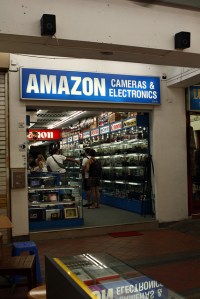
We saw the store on the photo below in Chinatown Singapore. It looked like it sold cameras and other electronic goods. What caught my eye was the name of the store, Amazon. I’m quite sure it’s not associated with Amazon the online superstore, but I suppose it’s not a trademark violation having a store with the same name.

Amazon camera store

Traditional Medicine

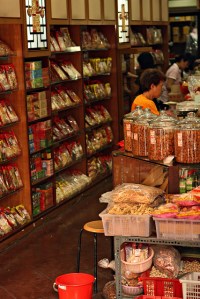
One of the stores that we passed when we walk around the Chinatown area in Singapore was a traditional Chinese medicine store. The store is like a traditional version of a pharmacy. They have pre-packaged medicines as well as made-to-prescription mix of medicine for various kinds of ailments. The difference is that they have ingredients that might be unusual or even off-putting to westerners — things like some dried plants, herbs, insects, and other things sourced from the nature that one may not think have medicinal value.

I didn’t have much experience with traditional Chinese medicine until a few years ago when my dad had a stroke. Fortunately it was not fatal, though he loss ability to control parts of his body. Since then, my dad went through various kinds of treatment and physical therapy methods. As part of those, we had a mix of both western/modern type treatments as well as some more traditional supplements that were recommended by others we knew.

During the initial few weeks of the treatments, we took my dad to a Chinese medical clinic in Jakarta that was a branch of an institution in China. He went through several acupuncture sessions performed by a Chinese doctor. The doctor also prescribed some medicine for him. We took the prescription to the in-house pharmacy where we could see the pharmacists prepared a mix of various natural ingredients that once they were mixed together, they were packaged into portions that were meant to take home and consume three times a day. Typically this means taking the mix and brew it in hot water, and the patient was supposed to drink it. My dad said it tasted quite nasty, but I guess that’s what medicine is like.

In today’s world, especially in a place as modern as Singapore, it is interesting to see that people are still using the traditional medicine, sometimes in place of using modern medicine. With the advance in medical field, sometimes we question anything that may not necessarily backed by scientific research. We tend to believe in modern drugs and may think the effectiveness of traditional medicine. But I think one should consider the fact that while the traditional medicine may not be the product of scientific research, sometimes these are prescribed methods of treatment that has been used in centuries and passed on through generations. I know in my family’s case, we kept an open mind on anything that potentially could help improve my dad’s conditions, and evaluated any methods with our own research and advice from those we know who are from the medical field. It’s important to ensure that you don’t experience unintended side effects when you mix modern and traditional medicine.

Chinese medicine store

Sunday Morning in Chinatown

When traveling, sometimes you can learn and appreciate the local culture simply by observing the locals go about their daily lives and compare what you see with what you know from your own culture or background.

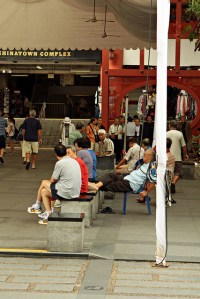
It was still quite early on Sunday morning in Chinatown Singapore when we walked around to explore the neighborhood. Many of the stores were still closed, but there were some people already walking around. Some were tourists as we could tell from their cameras and backpacks that they carried (just like us). But others you could tell were locals — some looked like they lived in the neighborhood and simply were going out for a walk in the neighborhood.

As I was waiting for Kristi to go to restroom at one place, I noticed several elderly Singaporeans sitting around on the bench in front of a shopping building. Some were dressed like they were out for exercising (in shorts, polo shirt, and wearing sneakers). Others were simply wearing casual clothes and sandals, very relaxed. This scenery reminded me to home in Indonesia, specifically to my late grandfather, my dad, and my uncle, who would go out for a morning walk in the neighborhood or get up early to join a group doing some exercise program. It’s partly to start the day right with some healthy activities, but it’s also to socialize and meet friends or neighbors. I thought it’s interesting to compare this to other cultures — elsewhere people would get together frequently to play games, having coffee or meal together, or simply just hanging out and watch life goes by; different activities, but with the common idea of sharing life with friends. In a way, it’s a nice change of pace from the hustle and bustle of living in cities.

Chillin on Sunday morning

Singapore’s Chinatown

Singapore’s Chinatown is different than a typical Chinatown area in other world’s cities. Usually Chinatown exists in a city where the Chinese community is the minority. In Singapore, that’s not the case; the Chinese ethnic group is among the major ethnic groups in Singapore. The Chinatown area near the CBD (known to locals as Kreta Ayer) is historically the area for the Chinese to live designated by the ruling government when Singapore was a British colony (similar areas were designated for other ethnic groups like the Malays, Indians, and Arabs). Today the Chinese live throughout the island of Singapore, but the Chinatown area remains to be the centre of Chinese culture activities. It is also a popular place to visit in Singapore for foreign tourists who want to experience and learn about Singapore’s Chinese heritage.

We walked around the streets of Chinatown after breakfast at the Maxwell Road Hawker Centre. It was still pretty early in a weekend morning, so many of the stores were still closed and the foot traffic was still pretty light. But we did get a glimpse of what the area was like — many buildings built in old architectural style, juxtaposed against tall skyscrapers in the background. Aside from the obvious tourists like us, there were also many locals who went about their normal weekend morning.

The photo below was taken from the corner section of the neighborhood. The big building in front is a Buddhist temple, and next to it is the start of the Chinatown neighborhood with its distinct architectural style. The neighborhood consists of several blocks with narrow streets and alleys that you can explore by foot.

Singapore Chinatown