One Night in Singapore

The last stop of our Southeast Asia trip was Singapore. We didn’t have much time left on our two-week trip, but we thought since Singapore was on the way home from Vietnam to Indonesia, we would at least include a stopover there.

For westerners coming to visit Southeast Asia for the first time, Singapore is often considered as the ‘Asia 101.’ The city is very modern and structured. Its airport, Changi International Airport, is considered as one of the main hubs in Asia, so you can easily find flights to Singapore from all over the world. You can get around with English easily, and the public transportation is very accessible in the small city-state area. Yet the influence from various cultures that make up Singapore population — Chinese, Malay, Arab, Indian — are still quite strong, so you can get a taste of those cultures during your visit in Singapore.

Given its close proximity to Indonesia, visiting Singapore is similar to Americans visiting the neighboring country of Canada. Many Indonesians would go to Singapore for short vacation. Some of my high school friends now even live and work in Singapore given the availability of job opportunities especially in high tech sector. For Indonesians, the two main attractions of Singapore are shopping and food. For Kristi and me, we didn’t care so much for the shopping part, but the food part definitely was the main draw.

Prior to this trip, I had only been to Singapore (if you could call it a ‘visit’) for few hours during a transit at Changi International Airport. So it’s pretty much all new to me. Kristi had been in Singapore several times before with family and friends. But she had not really spent time exploring the culture there before either. We only had less than one day to spend in Singapore (arriving in an afternoon, leaving again the following afternoon), so it had to be somewhat well-planned to make the best use of our time there.

We decided to use food as our ‘theme’ for the visit, so the goal was to try out several unique Singaporean dishes while we were there. As a guide, we decided to look at some Travel Channel programs covering Singapore: Anthony Bourdain’s No Reservations, Andrew Zimmern’s Bizarre Foods, and Samantha Brown’s Asia. We found information about some of the places these hosts visited, and decided to follow suit after seeing confirming good reviews about those places. Along the way, I also wanted to visit places that are uniquely Singapore like the downtown area, Raffles Hotel, Chinatown, and Little India. Quite ambitious for less than 24-hour visit, but we would give it a try.

The photo below was taken in an area in downtown Singapore called One Fullerton. You can see the iconic statue of Merlion, which is the mascot of Singapore.

Merlion

Vietnam Airlines

Vietnam Airlines is the national air carrier of Vietnam. It has Hanoi and Ho Chi Minh City as its hubs, and it serves domestic destinations within Vietnam and several international destinations.

During our Southeast Asia trip, we took Vietnam Airlines flights in to and out from Hanoi. Initially we looked for bargain priced flights through low cost carriers like AirAsia and JetStar, but we found that while we could find flights at reasonable price, the route and timing were not ideal for our trip. We were looking for direct flights from Siem Reap to Hanoi and from Hanoi to Singapore that also minimized travel times so we could spend more time at the destination cities. In the end, the best timing and cost balance were with Vietnam Airlines flights.

I booked the tickets directly on Vietnam Airlines website. The bookings were quite straightforward, though there was a catch that you may want to watch for especially if you’re booking using your credit card. The transaction would be billed from Vietnam, so it would be considered as if you’re using your credit card there. For some credit cards, that would mean you need to pay foreign transaction fee that typically amounts to about 3% of the transaction amount. In my case, I did end up paying the fee as I didn’t know this and I used my credit card that did not have foreign transaction fee waiver.

Our first flight with Vietnam Airlines from Siem Reap to Hanoi was in business class. The cost was almost double the amount for economy seat, but it was still pretty reasonable (less than USD 500 per person) and it was the most convenient timing for our schedule (at least on paper). It turned out however that the flight was delayed for almost three hours, and we ended up arriving late in Hanoi that pretty much changed our original plan to go out for dinner in Hanoi. Since we had business class seats, we could wait in the business lounge at the Siem Reap International Airport, so it was more comfortable and nicer than the regular waiting area. The flight itself was pretty nice and uneventful, and the food served was good; pretty much a Vietnamese-western fusion dish.

The second flight with Vietnam Airlines was from Hanoi to Singapore. This time we tried to fly on the earliest flight out from Hanoi to Singapore so we could spend more time in Singapore. However, similar to the the first flight, our flight was again delayed, though thankfully this one was only two hours. We used the time at the Hanoi Noi Bai Airport to look for souvenirs, so all was not lost. But it did mean we had shorter time to spend in Singapore than what we planned. The flight again was nice and uneventful. The economy cabin was still pretty good; I’d say it’s comparable to any airlines you fly here in the United States.

Overall, I think I would consider flying Vietnam Airlines again especially for the domestic flights in Vietnam and when they have good route, time, and price. However, given my previous experience with them, I would at least consider a Plan B on my trip in case the flight gets delayed again.

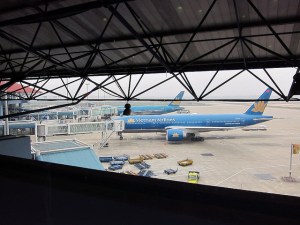
The photo below was taken at the Hanoi Noi Bai Airport from the terminal that seemed to be exclusively for Vietnam Airlines. You can see the Vietnam Airlines planes at the gates waiting for the passengers to get on board.

Vietnam Airlines

Souvenirs from Vietnam

Souvenirs… When traveling somewhere, you often think of bringing something home from the place you visit as a way to remember the experience on the trip or a way to share the experience with someone back home who didn’t go on the trip. Sometimes this aspect of traveling can become a stressful part of the trip in itself, especially if you already have something in mind to get for one or more people, and you have to set aside your precious traveling time to look for the souvenirs.

You can get the souvenirs at the earlier part of your trip to get this out of the way. But then you would have to lug the souvenirs around as part of your traveling baggage — not a good thing if you still have a long journey to go. If you get the souvenirs towards the end of the trip, you won’t have this problem, but then you’d be thinking about this all trip long, and perhaps the last stop of your trip may not be the best place to get the souvenirs. Other considerations to take account are who you will get the souvenirs for, what to get them, and how much you’re willing to spend on souvenirs. The worst possible thing to do is to get an expensive souvenir for someone who doesn’t care or appreciate the gift.

During our Southeast Asia trip, Kristi and I considered this aspect from the beginning. We were going on a two-week trip to four countries, and we had many family members and mutual friends to consider. So what to do?

First of all, Kristi made a smart move to purchase extra luggage weight allowance for the last leg of our trip on AirAsia. Apparently if you don’t do so, you may have to pay more expensive excess baggage fee at the airport given the fairly restrictive luggage weight allowance. Then we thought of who to get the souvenirs for, what to get, and where to get them. There were at least eight families in addition to her family and my family to consider. We decided to get the same thing for all of them (so there is no favoritism), and we thought of something that was unique to the place we visited and most in the family we knew would enjoy… Vietnamese coffee. This would work quite well as Vietnam was close to the end of our trip, and the total cost was quite reasonable.

When we were in Cambodia, we also got silk scarves for a couple of mutual friends in the US. That’s also a unique, local product to Cambodia, and they were quite lightweight and didn’t take much space during the travel. Kristi also purchased a pair of wooden sandals in Hanoi for her mom, as she specifically asked for those. I also got a little wooden statuette to take home for myself from Vietnam. All in all, I think we were able to get things to take home without stressing ourselves or our budget.

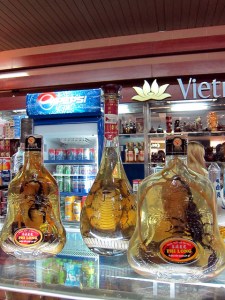
We bought the bulk of the souvenirs at the shops at the Hanoi Noi Bai Airport while we were waiting for our flight to Singapore. Not ideal and I’m sure we could’ve found better price outside the airport, but we didn’t have much time to spend to look for these while we were in town. As we perused the available souvenirs, we saw the item on the photo below, a wine bottle with a snake in it. It’s an extreme souvenir and for sure would be memorable, but I’m not sure how practical it would be to get this and carry it around during the trip.

Extreme souvenirs

Fruit Snacks

Given its location and climate, the Southeast Asian region is blessed with abundance of fruits; some are unique to the area. As such, fruits make popular snacks among the locals. They are cheap and easily available year long, healthy, and can be refreshing treats especially in the middle of the day in a hot, tropical weather.

You can get the fruits either at a traditional market, the more modern supermarket or convenient stores, or from streetside vendors. Just like buying fruits or other fresh produce anywhere else, you should pay attention and make your selection carefully to make sure you get the fruit at the right level of ripeness. This can be tricky, especially if you’re getting some fruits that are unique to the region and you had never seen or tried before. In that case, you may want to get assistance from locals who know better about the fruits to help you pick the right ones.

When you’re getting fruit from street vendors, chances are they’ve already selected the fruits that are at the right level of ripeness to be enjoyed immediately. You do want to pay attention to the hygiene level of the vendor and how he/she handles the fruit before serve them to the customers. When we were in Bangkok, Thailand, we got some fruit snacks at a vendor in a night market. There she actually cut the fruit to pieces to order, and the utensils she used seemed clean. Also, the fruits served were the ones familiar to foreigners (like pineapple, mango, and watermelon). When we were in Cambodia, Kristi got some pineapple from a vendor at a market. There, the whole pineapple had been cut up in large pieces and put inside a plastic bag.

Yet in some other places, the fruits have been cut up, and in some cases, are mixed with some local spices or flavor enhancers. That you may need to be careful with, not so much because those are bad, but because your body may not be used to the spices or even the taste of the fruit itself that you can get bad reaction from it. I’ve heard of stories of adventurous traveler who ended up spending several days of his trip with gastrointestinal problems after eating what seemed to be delicious local fruits.

When we were in Hanoi, on the way back to the hotel after watching the water puppet show, we passed the night market area again and Kristi spotted a fruit vendor. She was curious looking at some fruits that the vendor had on display, as those didn’t look familiar to us. So she did get a bag full of little fruits that were similar to plums or cherries. The fruits were served with a typical condiment in Southeast Asia, a mix of salt and chili powder. When we tasted the fruit, it was sweet and sour. It tasted even better when we added the salty and spicy condiment. It was good, but I could only have them in small quantity as I think I would get stomach upset from having too much of the very acidic fruit.

On the photo below you can see the vendor and her fruit selection at the night market in Hanoi. The ones that we had were the reddish fruit in front of the lady in the middle.

Fruit vendors

Water Puppets

Water puppetry is a traditional art form in Northern Vietnam. It dates back to 11th century when it originated in the villages of the Red River Delta. Traditionally the performance was done in a waist-deep water. Originally it was done on the flooded rice fields in the villages, now it’s done in a special theatre with a pool in front as the stage. The performance is accompanied by a traditional music ensemble, including a vocalists who would sing songs which tell the story being acted out by the puppets.

One of the well-known water puppet troupes in Vietnam can be found in Hanoi. So if you are interested in traditional performing arts in Vietnam, this is a great place to experience that. The Thang Long Water Puppet Theatre is located at the northeast side of the Hoan Kiem Lake, so it’s convenient to go to the performance while you’re exploring the Old Quarter area.

There are several performances offered each day. You have to get tickets to attend the performance. On our first day in Hanoi, we tried to get tickets for performance that day that would fit our schedule. Unfortunately all the shows were sold out. But on our last night in Hanoi, we tried again, and this time we were able to get tickets for the night’s performance.

The show we attended was quite packed, mostly with foreigners. The songs performed were in Vietnamese, so I didn’t quite understand the story line, but from watching the skits done by the puppets, it seemed to be based on some traditional folk tales. Even without understanding the words, it was still an enjoyable experience. The singers and musicians performed the soundtrack beautifully, and the water puppets moved in a nicely choreographed manner.

The photo below was taken from our seats all the way at the back of the theatre. You can see the stage set up with the musicians playing on the left.

Water puppet