Khmer Empire

The most popular place to visit in Cambodia is the Angkor Wat. While in itself it’s already quite impressive being the largest religious structure in the world, it’s even more impressive to learn that it was only one of many temples in an area called Angkor that at one time was the largest pre-industrial city in the world (about 1,000 square kilometres in area — more than 10 times the size of Manhattan). This was during the heights of the Khmer Empire, between the 9th and 15th centuries. The Khmer Empire at its height spans all the way to modern day Thailand in the west, the modern day Laos in the north, and the modern day Vietnam in the east.

During our visit to the Royal Palace in Phnom Penh, we also saw some museum display that showed artifacts from the Khmer Empire era, and particularly interesting to me was seeing a map of the Khmer Empire superimposed on the geographical map of the modern world — clearly showing how vast that empire was. I couldn’t help to think of the contrast between seeing this map that in a subtle way saying the Khmer culture is more superior than its neighbors the Thai and the Vietnamese, and seeing the model of Angkor Wat at the Grand Palace in Bangkok, Thailand, which was built to commemorate the time when the Thai conquered the Angkor area. It’s interesting to think of these two cultures that are both deeply rooted in Buddhism (thus advocating peace and not being confrontational), but they still have the nationalistic pride when comparing themselves with their neighboring countries.

The photo below was taken at the museum in the Royal Palace. It was the Khmer Empire map I mentioned above.

Khmer Empire map

Cambodian Traditional Music

When you’re visiting a foreign country, one way to appreciate the local culture is by by listening or watching traditional performing arts like dances and music. Some cultures have traditional music instruments that might be unique only to their culture, while others may have traditional instruments that are similar to other cultures in the same geographic region. Some of the music pieces are performed among the common people, while others are more for formal, royal functions.

When we were visiting the Royal Palace complex in Phnom Penh, Cambodia, while walking around the Silver Pagoda we heard some sound of music playing in a distance. We walked towards the sound source, and found a pavilion where several people were playing traditional musical instruments as an ensemble. Later on I learned it’s called the pinpeat ensemble, which plays music during ceremonies at the royal court or the temples. The ensemble includes wooden xylophones, a circle of small gongs, and a couple of drums. The music sounded similar to the gamelan ensemble from Indonesia.

As we stood near the pavilion and listened to the group performing, several more tourists came to join us enjoying the performance. Then one of the performers looked at the crowd, and motioned to one of the visitors to come over, and he let her played the instruments for a little bit. I thought that was a wonderful way of letting visitors learn and appreciate your culture.

The photo below was taken as we listened to the group performing. I thought it was great that one of the guys actually looked at us while playing and smiled — showing that it’s not all about being serious and the music was meant to be enjoyed.

Pinpeat ensemble

Silver Pagoda

The Silver Pagoda is a temple within the Royal Palace complex in Phnom Penh, Cambodia. I first learned about the Silver Pagoda as it was one of the places in Cambodia included in the popular travel book ‘1,000 Places to See Before You Die’ by Patricia Schultz. The building was known as the Silver Pagoda because its floor was covered with more than 5,000 silver tiles (though except a small area that was exposed for visitors to see, most of the floor was covered with thick carpet to protect the silver tiles). The Silver Pagoda was no longer used for worship. Instead, it’s used to house some of the Cambodian’s national treasures, such as the gold Buddha statues of many sizes. Most notable was the ‘Emerald Buddha’ and a large, life-sized Buddha that was covered with more than 9,000 diamonds.

Though the purpose was probably similar to Wat Phra Kaeo within the complex of the Grand Palace in Bangkok, Thailand, one notable difference between my visits to these two temples was the current function of the temple. Wat Phra Kaeo is still actively being used for worship, with the Emerald Buddha statue housed there. The Silver Pagoda on the other hand is now used as museum; I don’t think it’s used for worship anymore. For reading about it what’s remarkable was the fact that the Khmer Rouge spared the temple and its content, even though they pretty much ransacked everything else (you could tell how bad it was left with the Ramaketi frescoes on the wall outside the temple that is currently still being restored — it’s a long ways to go before it could be to the level of the frescoes at the Grand Palace in Bangkok. From what I read, it seemed that the Khmer Rouge left the Silver Pagoda alone in a way as a PR statement to the outside world that they still valued some of the Khmer heritage. Regardless, I think we’re fortunate that these treasures remained preserved that now the world can get a glimpse of the richness of the Khmer culture and history.

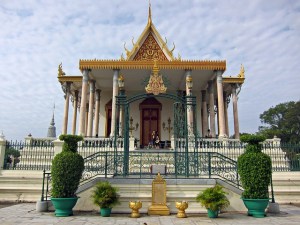
The photo below was taken outside the Silver Pagoda. It was a wonderful, cloudy morning. Not too hot and the sunlight was not harsh; perfect for photography.

Silver Pagoda

Royal Palace

The Royal Palace in Phnom Penh, Cambodia, has been the residence of the king of Cambodia since 1866, with a period of absence during the reign of the Khmer Rouge. One prominent building in the complex was the Throne Hall. This building was used only for important ceremonies like the king’s coronation or royal weddings. Behind the Throne Hall, there was a building behind a closed off and guarded gate. The building was the Khemarin Palace, the official residence of the king of Cambodia, King Norodom Sihamoni. Aside from these two buildings, there were a couple of buildings that were open air pavilions where traditional dance performances were performed, and there were several other closed-off buildings that seemed to be used for offices. On the south side of the Royal Palace complex, there was a long wall decorated with Ramaketi (the Khmer version of the Hindu epic Ramayana) frescoes, several large stupas commemorating past Cambodian royalties, and the royal temple known as the Silver Pagoda. The whole set up was very much similar to the Grand Palace in Bangkok, Thailand.

We visited the Royal Palace as our first destination during our full day visit to Phnom Penh. When we arrived there, we just had to purchase the entrance ticket, and then just walked into the complex to visit areas that are open for the public. It wasn’t as crowded as the Grand Palace in Bangkok. Inside the complex we could walk around and check out the interior of some of the buildings, but many were closed off. Unlike the Grand Palace in Bangkok that is used for ceremonies but is not the actual residence of the King of Siam anymore, the Royal Palace in Phnom Penh is actually the residence of the King of Cambodia, King Norodom Sihamoni. So we could observe a closed area with armed guards watching the entrance gate. Many visitors came with tour guides (they are easily recognizable because official tour guides in Cambodia had to wear uniforms when they’re on duty). We didn’t have one, so we just had to rely on our own guidebooks and the pamphlet handed out at the ticket booth. The palace is not as glitzy as the Grand Palace in Bangkok, but it’s still showing the dignity of the people of Cambodia, and provided some reminder of the past glory of the Khmer Empire.

The photo below was taken inside the complex. This was the Moonlight Pavilion that can also be seen from outside the complex. This particular pavilion has a balcony where the King can stand and watch One of the most notable buildings in the palace complex as it’s easily seen from outside. This pavilion had a balcony where the king could see parade passing by the boulevard outside the palace.

Moonlight Pavilion

False Start

Few days ago I wrote about being out of my comfort zone when traveling to a foreign country. This feeling continued on to the second day of our visit in Phnom Penh, Cambodia, as we were totally dependent on logistical arrangements made online with a travel agency located in a city few hours away. My fear of logistical problem did materialize, but in the process we experienced the hospitality of the locals and we tried out tasty local foods. So here is the story…

We got up very early on our full day in Phnom Penh. The tour company that organized our trip in Cambodia had arranged to have a driver coming to pick us up for the day at the hotel at 7 am in the morning. Other than the time, I did not have any other details about the pick up, so I decided to be ready and wait in the lobby few minutes before the scheduled pick up time to make sure that the driver would not miss us.

I was ready to go and went down to the front area of the hotel by 6:40 am. It was still pretty early for the hotel operation. The restaurant was not open yet, and the front desk staff had not arrived either. There were a couple of the hotel staff members at the restaurant setting up the area to start the day, and another hotel staff cleaning the swimming pool area.

7 a.m. — and there was no one coming. I continued waiting for 15 more minutes, and still no one showed up. I started to get concerned, and walked to the street outside to check out, and walked back in. The hotel staff member who was cleaning the swimming pool area noticed that, and asked me if I was waiting or looking for anyone. I told him that we’re supposed to be picked up at 7, but our ride had not arrived yet. I asked him to help watching the front entrance, and to let me know if he saw anyone coming to look for me.

7:30 a.m. — and still there was no driver. By this time I was getting very concerned, so I looked for contact information for the tour company to call. The tour company was based in Siem Reap, and it was still quite early in the morning, so I was not sure whether I would be able to get hold of anyone. I tried calling using my Blackberry which should work in Cambodia (using Indonesian SIM card), but I had difficulty with making the call. So I went to the hotel front desk to get assistance. The front desk staff had just arrived and was in the middle of preparing for the day. When she saw me coming, she stopped her work and helped me dial the tour company’s number. She was very helpful especially in making the initial connection in Khmer before handing the phone to me when she was able to connect me with the tour company contact person.

Fortunately the tour company contact was there to answer our call, and after a few minutes he found out that there was a miscommunication with the driver they arranged for us in Phnom Penh about the start time. Typically day trips in Phnom Penh start at 8 am because the typical first destination, the Royal Palace, was not open until 8 am anyway. Our tour agent changed the start time for our day to 7 am when I told him that we also wanted to visit the Choeung Ek Killing Fields, which was located outside Phnom Penh. Apparently that wasn’t communicated clearly with the driver. Our tour company contact apologized profusely for this mishap, and said that the driver was on the way to pick us up. I told him not to worry; the important thing was that we knew that the driver was coming.

While waiting for our ride to arrive, I saw the hotel staff that I talked with earlier going to the front gate and stopping a food cart that was passing by. He ordered something – breakfast I guess. We had not had breakfast, and the hotel’s restaurant was still closed, so I went outside and asked the hotel staff what it was that he ordered. He said it’s a typical Cambodian sandwich. It looked pretty good, so I asked him to help me order two of those sandwiches for me and Kristi. He helped me translating between Khmer and English as I attempted to communicate with the food cart vendor.

We had the breakfast sandwich (later on I learned it is called num pang sandwich, very similar to Vietnamese banh mi sandwich), and not long after that a gentleman showed up at the gate, looked around, and when he saw me, he mentioned my name. He also apologized for picking us up late, and I told him it was okay. We started later than planned, but in the midst of the mishap, we experienced local hospitality and had delicious local sandwich for breakfast.

The photo below was taken right outside our hotel as I waited for the sandwich man prepared our num pang sandwich.

Num pang sandwich cart