Amok trei

After visiting Ta Prohm, it’s time for us to take a lunch break before continuing our visit in the Angkor Archaeological Park outside Siem Reap, Cambodia. Instead of taking longer time to drive to Siem Reap for lunch and back, our tour guide Vanna suggested that we should go to a restaurant located not far from Ta Prohm called the Khmer Village Restaurant. By the time we arrived at the restaurant, it was already 1:30 pm or so, so some of the lunch crowd had already left, but the restaurant was still quite full. Given its location pretty much inside the Angkor Archaeological Park, you could tell that it catered mostly to the visitors of the Park.

We wanted to try another traditional Khmer dish while we were there, and one dish I read that is a popular dish in Khmer cuisine is amok. Amok is a curry dish with coconut milk-based gravy that is cooked in banana leaves. It can be served with various kinds of meats, but the popular one in Cambodia is with fish, called amok trei. I wasn’t sure what kind of fish was used for ours, but I’m guessing it’s likely from fresh water fish like most things in Cambodia. When the dish was served and we tasted it, like some other dishes we had in Cambodia, we could taste something new and unique to Khmer cuisine, but at the same time it seemed familiar as parts of the dish were similar to dishes we have in Indonesian cuisine. I think it was somewhat like in between gulai (the gravy was not as thick and strong flavored) or opor (it wasn’t as soupy). It also resembled a Thai curry dish — not surprising given the regional influence of these cultures on each other.

The photo below was the amok trei dish that we had just before we tried it out. It wasn’t served in banana leaves container, but it had all the flavors that you would expect.

Amok trei

Suvarnabhumi Airport

The Suvarnabhumi Airport is the main international airport in Bangkok, Thailand. The airport is pretty new; it was opened in 2006 as a replacement of the Don Mueang Airport. The airport today is one of the busiest airports in Asia, particularly as a gateway for tourism to Thailand and the nearby countries.

When we arrived at the Suvarnabhumi Airport, my first impression was very good. The international terminal was modern, clean, and comparable to some of the better airports I had visited. Though there were many Indonesians on the Thai Airways flight I took from Jakarta to Bangkok, once we got to the terminal, it felt like we were in a western country’s airport as there seemed to be a lot more westerners/Europeans than Asians. When we got to the immigration line, it was interesting to observe there were so many Eastern Europeans there — it seemed that Thailand has become a popular destination for tourists from Eastern Europe.

The airport is located quite a ways east of the downtown Bangkok area. If you know where you’re going and your destination is within walking distance from a Bangkok Skytrain/metro station, there is a train system conveniently linking the airport to the metro system. That’s probably the cheapest and actually the most predictable way to travel time wise. Alternatively you can hire a taxi like we did. You can find the taxi line easily, but if possible you want to have the address of your destination written down, preferably in Thai. Our taxi dispatcher was a bit confused looking at our hotel direction, but was able to determine roughly where we were going. Our taxi driver attempted to talk to us in broken English, and Kristi tried to start a conversation in the car, but the two of them ended up confusing each other, so they ended up stopping the conversation and just used hand gestures to communicate. Our hotel was located in the southwest side of Bangkok, so it was quite a long distance to get there. It was Sunday night, however, so the traffic was not bad at all.

On the day when we’re supposed to leave from Bangkok to continue our trip to Phnom Penh, Cambodia, our hotel manager generously offered to have the hotel’s car taking us to the airport instead of our original plan of taking the SkyTrain. It was around noon, so we got caught in downtown traffic for a bit. Fortunately we made it to the airport with plenty time to spare.

After checking in the luggage, we actually had some time to kill. We decided to go to a lower level of the airport building to look for food since we had not had lunch. There was one floor that was full of restaurants serving quite a diverse set of cuisines. Walking through there felt more like being in a shopping mall than being at an airport. We found one restaurant that seemed to have authentic Thai food, so we decided to go with that as our last meal in Bangkok.

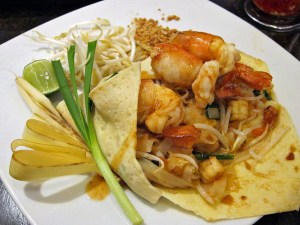
The photo below was the dish that I ordered for lunch, pad thai with Mekong River prawns. I wanted to try pad thai during the visit, but our schedule was so packed the day before, so there was not a time to look for authentic or street-side pad thai. The one we had at the airport was surely more expensive than what you could get on the street, but I must say they did good job with the dish, and it had quite a nice presentation with a thin layer of egg used as a pouch (rather than typical shredded eggs on the dish). And the Mekong River prawns were quite good, fresh and sweet.

Pad thai

Thanying

Thanying is a restaurant located near Silom Road in Bangkok, Thailand. The restaurant serves Royal Thai Cuisine, which is essentially Thai cooking but specifically derived from recipes of dishes served for the Thai Royal family. So it’s sort of a ‘refined’ version of Thai food.

When you come to Bangkok, you definitely need to try the authentic Thai food. The best Thai food actually is found on the street — the cheap and authentic food that the locals eat. But if you want to have a nice, fine-dining type experience, you may want to check out one of the restaurants that serve the Royal Thai cuisine. They are generally more expensive than their street food equivalents, but you may also enjoy the dining experience better.

I first learned about the Royal Thai Cuisine when watching Andrew Zimmern’s Bizarre Food episode on Bangkok. In that episode he went to Bo Lan, a trendy, up-and-coming fine dining restaurant in Bangkok that serves dishes based on age-old recipes. We initially considered going there for our first night in Bangkok, but then decided not to after finding out that the location is quite far away from the hotel where we were staying at, and also considering the price for the tasting menu was really high (especially for Bangkok standard). I found out about Thanying that also serves Royal Thai Cuisine. The restaurant was opened by a Thai Princess who was the head cook at the palace for her sister the Queen. The food seemed to be quite authentic, and it received good reviews from people who had been there.

We had good experience dining at Thanying. Instead of ordering the set menu, we decided to go ala carte and ordered a salad dish, soup, and a couple of select dishes. Everything we ordered was really good. My favorite dish was the salad, yam som o (pomelo — a large citrus fruit like grapefruit — salad with prawn). It was light and refreshing.

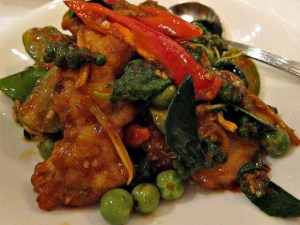
The photo below was one of the dishes we ordered, the pad cha (deep fried sea bass with red curry, green pepper corn, galangal, lime leaves, and basil leaves). It was not only a delicious dish, but also quite pretty and colorful to look at, and it’s a good example of a Thai dish with its fresh and varied ingredients.

Pad cha

Morimoto

If Philly cheesesteak is not your food of choice, or if you’re looking for a fine dining alternative in Philadelphia, at least there is a couple of names you can consider. One of the current Iron Chefs on Food Network’s Iron Chef America, Jose Garces, runs an empire of restaurants in Philadelphia area (Amada, Tinto, Distrito, Chifa, Village Whiskey, Garces Trading Company, and JG Domestic). Not only that he won the 2nd season of the Next Iron Chef competition, but also he received the James Beard Foundation Award for the Best Chef in the Mid-Atlantic region in 2009 for his work with these Philadelphia restaurants. So you have some options there to check out.

Another famous chef with restaurant in Philadelphia is the Japanese Iron Chef from both the original Iron Chef Japan and the Iron Chef America, Masaharu Morimoto. Several years ago he opened his own restaurant, Morimoto, in downtown Philadelphia. It was quite highly publicized; Food Network even ran a special documentary feature on the process of opening this restaurant.

A couple of years ago I was working on a project assignment in Philadelphia when I found out that an old graduate school classmate and work colleague was also going to be in Philadelphia for business. We decided to meet up for dinner, and also invited another classmate whom we found living in the suburb of Philadelphia. Both of us are foodies (back when we both lived in Dallas we used to do an expensive pastime, sampling restaurants in the Top Restaurant List from Dallas Morning News’ Guidelive), and when I mentioned to him about checking out Morimoto, there was no hesitation at all.

The dinner at Morimoto ended up to be one of the most expensive meals I’ve ever had, but it’s also among the most memorable. The ambience of the restaurant was unique, and the meal was exceptional. We had high expectations after seeing Morimoto and his creative creations on the Iron Chef shows; we decided to go with the omakase meal (‘chef’s choice’ / tasting menu). They had three choices of omakase, at $80, $100, or $120 per person. The difference is in the quality of the ingredients used. We decided to go with the middle one at $100/person. Our other friend decided to go with a chef’s combination of sushi, sashimi, and rolls.

So here was the menu line up for us: toro (fatty tuna) tartare topped with caviar and fresh wasabi to open with, whitefish carpaccio thinly sliced with yuzu soy, hot oil, and mitsuba leaf as second course, sashimi salad with kanpachi (amberjack), micro salad, and vinaigrette as third course, a glass of apple mint soda as palette cleanser, grilled halibut wrapped in tofu with seaweed salad and miso beurre blanc as fourth course, wagyu (kobe beef) sirloin steak topped with trumpet mushroom and micro salad with dashi soy and hot mustard aioli as fifth course, toro (fatty tuna), hamachi (yellowtail tuna), ika (squid), tai (red snapper), and kisu (japanese whitefish) sushi as sixth course, and mint chocolate mousse cake with chocolate and caramel sauce as dessert to close. All were very delicious and beautifully presented, just like what you see in the Iron Chef show. If you wonder how I could remember all of these menu items — I had to listen carefully to our server’s presentation of the dish when each gets to our table, and then frantically typed in notes on my Blackberry to make sure I get it captured. In the end, it was an expensive meal, but I think it’s worth it if considering that it’s not just a meal, but it’s a complete dining experience.

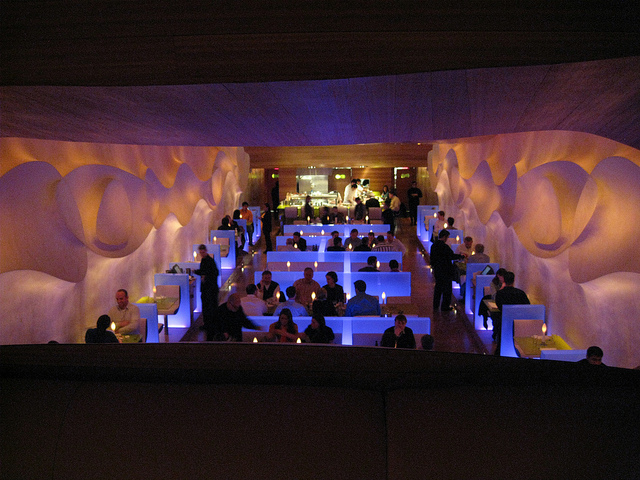
The photo below was the dining area, taken from the lounge area on the top level while we were waiting for our friend to arrive. You can see very colorful and cool ambient lighting; it was even cooler when we noticed that the light colors gradually changed every few minutes or so..

Morimoto

Philly Cheesesteak

If you ask a question to the Philadelphia locals about famous local food to try, very likely the answer is the Philly cheesesteak sandwich. The Philly cheesesteak sandwich consists of thinly-sliced steak meats with melted cheese served in a long roll. There could be variations on toppings, including different kinds of cheese, or the addition of sauteed onions.

While it’s likely the locals suggest that you try Philly cheesesteak sandwich, it’s not as obvious which place they would recommend to go to for the best Philly cheesesteak in town. Everyone has their own favorite place. The four popular places that are often mentioned are Geno’s, Pat’s, Jim’s, and Tony Luke’s. In some of these places, you would also be expected to know how to order your cheesesteak. There might be long lines of people waiting to order, so you need to know what you want by the time you get to the order window. And there is a particular syntax you need to follow.. you only need to say three words. First, how many sandwich you want. Second, what kind of cheese you want on it. And third, whether you want sauteed onion on it or not. So, if you want one Philly cheesesteak sandwich, with Cheese Whiz and with sauteed onion, you would order “one, whiz, with.” Or if you want one with provolone cheese and without the onion, you would order “one, provolone, without.” If you pause to try to decide, or worse, ask them questions or recommendations, the order taker might lose patience and tell you to step aside and go back to the back of the line while you’re trying to decide.

My first experience trying out authentic Philly cheesesteak sandwich was when I was on a road trip between Washington, DC, and New York City with my family, and we decided to stop in Philadelphia for lunch. We went to Geno’s and I had the orders down before going to the order window. The cheesesteak sandwich was quite good, though I remember more about driving through narrow roads of South Philly to find the restaurant (this was pre-GPS era), then finding parking on the street, and after the quick ordering, we quickly went back to the car fearing that it might be unsafe neighborhood (the surroundings near where we parked looked kind of shady). We ended up taking some time to navigate through downtown Philly with a road atlas, and then once we got out to the suburb, found a parking area at a fast food restaurant and had our cheesesteaks there.

The photo below was taken several years later when I went to Tony Luke’s. I found out about Tony Luke’s from watching this place featured on some TV shows (Throwdown with Bobby Flay and Man vs. Food). The location is also closer to the Interstate, so it’s not much of a detour to go there when I’m on the way to get elsewhere. They also have good number of parking spots across the street at the restaurant/bar owned also by Tony Luke. The sandwiches were quite good, you can tell many folks eating there are locals, and the order takers were not as strict in expecting you to follow the ordering ‘protocol’..

Tony Luke's