The Blue Pumpkin

The Blue Pumpkin is a pastry and ice cream store chain in Siem Reap, Cambodia. They serve freshly baked pastries, cookies, and breads, but people especially come to this place for its ice cream and sorbet. They serve sorbet with all kinds of unique flavors (many based on local fruits), and in a place like Siem Reap where it can get pretty hot outside, having something refreshing like some sorbet is definitely appealing to a visitors.

We found out about the Blue Pumpkin from the same British couple that suggested the Angkor Palm as a place for dinner. The Blue Pumpkin store location in the Old Market area of Siem Reap was right next door to the Angkor Palm. The British couple told us that they thought the Angkor Palm was a good place to eat, but regardless whether we eat there or not, they said save some room for dessert and don’t miss the Blue Pumpkin with its sorbet.

After finishing our dinner at the Angkor Palm, we were served some sorbet there to complete our New Year’s Eve special meal. We didn’t ask where the restaurant got their sorbet from, but we suspect it came from the store right next door from them. After we finished with our meal at the Angkor Palm, we went next door to the Blue Pumpkin, and we were quite amazed seeing the array of unique flavors that they had there — lots of local, tropical fruits that you wouldn’t find in a similar store in the US, like dragon fruit, passion fruit, jackfruit, durian, etc. I ended up getting the Khmer fruits sorbet, which was a combination flavor of several tropical fruits that actually worked quite well. The sorbet was quite light and refreshing; it didn’t feel too much even when having it after a dinner beforehand.

You can see on the photo below some of the flavors that they had at the Blue Pumpkin. It’s definitely a good place to go when you’re in Siem Reap, especially to cool down during or after a hot day sightseeing in the area.

Blue Pumpkin Flavors

Romdeng

We got back to our hotel around 4 pm after our day trip in Phnom Penh, Cambodia. It’s still too early to go for dinner, and we were exhausted mentally and emotionally after the day’s experience. So we decided to spend a couple of hours to rest and take it easy for the rest of the day.

For dinner, we decided to go to a restaurant called Romdeng. The restaurant was highly-rated for its authentic Khmer food. It was also unique as it served as a training restaurant run by an NGO to help street kids learning skills to work in hospitality / restaurant business.

Just like the previous night, we went outside our hotel to get a tuk-tuk to take us to the restaurant. The tuk-tuk driver from the previous night was not there, but there was another driver waiting for passengers out there. This time I discussed the price for the ride with the driver ahead of time.

The restaurant was only about 15-minute tuk-tuk ride from our hotel. On the way we got to see more of the night life in Phnom Penh. There were local street-side restaurants everywhere, similar to Bangkok and Jakarta. Romdeng itself was situated on a side street. The restaurant was housed in a big, old house. There were some tables outdoors under the trees, and there were some indoors in air-conditioned rooms. We were seated inside, and the ambience was pretty nice. The walls were decorated with artwork made by some of the students that the same NGO supported.

Since Romdeng was a training restaurant, the service was quite interesting. We had several people taking turns serving our table; the servers were mostly students who came with their teachers to our table. The students would do most of the work while their teachers observing their work. At times the students were not sure on how to respond to the customer’s request, so they would ask their teachers to help. At our table, the students did very good job in serving us. I could tell that some were being extra careful in doing their job as they knew their teachers were watching.

The food at Romdeng was very good. One particular dish that was popular among the foreigners who dined at Romdeng was a local delicacy that might be too extreme to try for many: the deep-fried tarantula appetizer. Cambodians started eating this out of necessity during the hard times, but over time it became a delicacy. We decided to give it a try. It turned out that it tasted not as bad as it looked. It tasted like eating chicken liver. It was cooked similar to Indonesian way of deep frying chicken liver and gizzard, with turmeric, coriander, and soy sauce to spice it up. So after the first bite, it wasn’t really that bad or scary for us.

We also had a refreshing salad dish and a fresh water fish dish. Both dishes were good. To close, we ordered a couple of desserts, a rice flour and turmeric crepe with caramelized banana filling and coconut gelato topping, and banana-filled rice dumplings with palm sugar syrup. The crepe was a great ‘east meet west’ dish. The rice balls were good as well, but they were too filling to have after the meal.

As we paid for our bill, we were asked to fill a survey to rate our dining experience. I thought that was a good way to provide feedback to the program. Judging from our own experience and the other patrons at nearby tables, I think everyone was satisfied with their dining experience. I know personally I would definitely come back to Romdeng the next time I’m in Phnom Penh again.

The photo below was taken as we’re about to try the first dish delivered to our table… the aforementioned deep-fried tarantula appetizer. As you can see, it’s presented quite nicely, though you can still tell those are tarantulas that we’re about to eat.

Deep-fried tarantula

McCafe in Bangkok

McDonald’s is one of the most well-known American fast food chain restaurants in the world, with more than 33,000 locations in 119 countries. In the United States, in the recent years McDonald’s and other fast food restaurants are getting bad rap because of the nutritious value of the items of their menu, and the tendency to promote large portion of the food (there was a documentary called Super Size Me few years ago following a person doing an experiment of eating nothing but McDonald’s food for 30 straight days and then observing the negative impact that had on his health). Along with that, as obesity is also becoming a big problem in the American society, there is more and more emphasis on eating healthier and, for many this means avoiding eating fast food altogether. I myself generally don’t eat at McDonald’s, except once in a while when I’m on the road, needing a break, and having local McDonald’s conveniently available somewhere as a rest stop.

One thing interesting is to see how different people in other countries view McDonald’s restaurant. Rather than being a common place restaurant that in many cases are being avoided, in other countries (at least I observed this in Indonesia and Thailand), McDonald’s is actually viewed as a foreign restaurant that is actually a cool and trendy place to visit. It’s an American thing — and for many, that’s different and actually valued (I guess it’s similar to Americans looking at ethnic restaurants as a cool thing because it’s a rarity — even though in the country of origin the food served there might be common place).

When we visited Bangkok, Thailand, after spending several hours walking in the hot and humid outdoors, we saw a McDonald’s with a McCafe in it near the touristy Khao San Road area. Though in most cases we would prefer going to local establishments and try something local, we couldn’t resist the thinking of going to an air-conditioned restaurant and getting nice, cold drinks from a menu that we somewhat knew already, and knowing that very likely it followed standard quality guidelines. So sometimes having something that’s of a known quantity is a good thing.

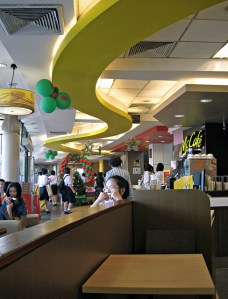
The McDonald’s and McCafe that we visited were pretty much like a standard restaurant setup I’ve seen in the United States. I didn’t pay much attention to the McDonald’s side of the restaurant to see its menu (in Indonesia the McDonald’s store has items not found in American McDonald’s and targeted towards the locals, like rice porridge or fried chicken with rice), but the McCafe side pretty much had similar menu like the American stores. As for clientele, it was pretty interesting to observe. Given its proximity to the backpacker/budget traveler area of Khao San Road, we noticed many westerners coming there — looked like folks who might’ve been homesick or craving familiar food from home. But more peculiar was to see so many teenage girls in school uniforms coming in and out; many seemed to just come in to hang out with their friends. The staff didn’t seem to mind even though many didn’t really purchase anything from the restaurant itself. Later on, when we continued our walk around the area, we found out that there was an all-girls school nearby — that’s why there were so many of them coming to this restaurant.

The photo below was taken inside the McDonald’s while we rested from our long walk and enjoyed our cold drinks. You can see that it looked like a typical McDonald’s elsewhere, though the clientele of the restaurant seen here included mostly the local schoolgirls from the nearby area.

McCafe

Coconut Ice Cream

If you find a small local store that has been serving only one type of food for more than 60 years, it’s very likely a place that does that one thing very, very well, and you should definitely give it a try. Such place is the Nattaporn Ice Cream Shop in the Sao Ching Cha neighborhood. We found out about this place from an article on the website covering eateries in the Sao Ching Cha neighborhood. On the hot, sunny afternoon after eating a nice lunch at the meatball noodle soup store, we thought ice cream would be great to have before we continued on with our walk to the next destination during our full day visiting Bangkok, Thailand.

It took us quite a bit of time to find the ice cream shop, as it was tucked away on a quiet neighborhood street among residential areas. When we found the place, we had to wait for a few minutes since there were only three tables with 4 seats each, and those were all occupied. Once we got seated, we ordered the ice cream. I had the coconut ice cream that seemed to be the specialty of the place. You can get toppings on the ice cream. This is where this differs from the western counterpart; it has very different kinds of toppings to select from: red bean, taro, roasted mung beans, sticky rice, sweet corn — all natural toppings, none of the things you find in western ice cream shop (candies, chocolates, etc.). I had mung beans and sweet corn as my toppings. It was a unique combination of taste. I can’t say that the ice cream was that memorable, but the experience looking for the place, sitting outside the store, and enjoying the ice cream while watching neighborhood traffic passing by was definitely one to remember.

The photo below was taken from the street after we’re done eating our ice cream. You can see the little store with the tables and stools outside, and the blue basin and bucket outside where they would wash the bowls after you’re done with the ice cream. It may not be some people’s idea of great sanitary place, but the bowls seemed clean (you can watch them washing the dishes if you like) and 60 years of history means they’re doing something right.

Nattaporn Ice Cream

Meatball Noodle Soup

Sometimes unforgettable experiences start with the willingness to go outside your comfort zone. Such was our experience eating lunch at a noodle shop in the Sao Ching Cha area during our visit to Bangkok, Thailand.

When I did an Internet research to find lunch options after our visit to the Grand Palace, we found a website that seemed to be a great location to check out. It’s within walking distance from both the Grand Palace area where we were coming from and the Khao San Road area where we needed to go afterwards. There is also an easy to spot landmark, the Giant Swing, so we thought we would just find the Giant Swing, then follow the hand-drawn map from the website from there to locate the lunch options.

When we arrived in the area, I asked Kristi what she would like to eat for lunch. The guide from the website mentioned many places to check out, each specialized on a particular dish, and they all have the commonality of being local, street-level vendors that have been in the area for long time. Kristi said she wanted to have some noodle dish, so we picked several options from the list, and started following the map to find these stores. I had the description of the stores as well as map printed from the website to a PDF, and then sent to my Kindle. So conveniently we could look at my Kindle and looked around the neighborhood to find the streets and locate the stores.

Finding the streets on the hand-drawn map was not a problem, but once we reached the street, in some cases we saw several restaurants in a row that all seemed to sell the same thing. We couldn’t figure out from reading the description and looking at these stores which one is the one that’s actually featured on the website. To make it more discouraging, pretty much all of these stores didn’t have any writing in English, so not knowing how to read and speak Thai, we were not sure even how to approach ordering lunch there.

We continued our walk, and after finding a couple of the restaurants featured on the website, but refraining from entering/trying as we didn’t see anyone else around (it was around 2 pm, so it could be that lunch hour was already over), we finally found one small restaurant that was also on the review, and seemed to have good food. It smelled good from outside, and we saw many people (all locals) eating inside. We hesitated, but the lady who was cooking at the open kitchen at the front of the shop saw us, smiled, and motioned with her hands to invite us to come in. Still not sure, we decided to go ahead and try it out.

The lady didn’t speak English, but we could communicate with her with hand gestures. We pointed to the noodle soup dish that seemed to be their specialty, and she nodded and started preparing the food. We had no idea what we ordered, but we went along, waited for the soup bowls to be served. I still don’t know what the dish was called, but it was noodle soup with red, tomato-based soup and an assortment of meatballs, seafood, and pig’s blood pudding. Fortunately both Kristi and I had had these ingredients elsewhere before; it would’ve been a shock for some Americans who had never seen or tried these before.

I also ordered one item from their menu written on the wall in Thai. This particular one is recognizable from its logo.. Coca Cola. As we’re finishing our lunch, I looked at the page on my Kindle to read up about the place and compared the photos on the website with the surroundings to confirm that we’re indeed in the restaurant mentioned on the page. The shop lady noticed I was looking at my Kindle, and she pointed to it and smiled. I looked around, and then noticed an old lady coming from the back of the restaurant. It was the same old lady whose picture was on the website page. I showed the photo to the shop lady, and she called the old lady and showed the photo on the Kindle. Both of them smiled — very happy and proud to see their store on this electronic gadget brought by a couple of strangers who don’t speak their language. It was a memorable moment from this trip that I definitely treasure. And, in the hindsight, it would’ve not happened had we not gone outside our comfort zone and eating at this restaurant even though we didn’t know the language to communicate.

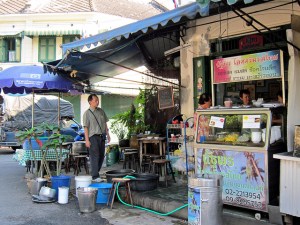
The photo below was taken from the outside of the noodle shop. I learned later on that the logo of the green bowl on the top left is ‘Shell Shuan Shim’ which is kind of like Michelin star or Zagat review that indicates recognition of the food quality at this place. The funny thing is that even the website simply called this shop as the ‘Shuan Shim noodle soup place’ — kind of like naming a restaurant as ‘the one with the Zagat logo’.

Noodle Shop