Khmer Empire

The most popular place to visit in Cambodia is the Angkor Wat. While in itself it’s already quite impressive being the largest religious structure in the world, it’s even more impressive to learn that it was only one of many temples in an area called Angkor that at one time was the largest pre-industrial city in the world (about 1,000 square kilometres in area — more than 10 times the size of Manhattan). This was during the heights of the Khmer Empire, between the 9th and 15th centuries. The Khmer Empire at its height spans all the way to modern day Thailand in the west, the modern day Laos in the north, and the modern day Vietnam in the east.

During our visit to the Royal Palace in Phnom Penh, we also saw some museum display that showed artifacts from the Khmer Empire era, and particularly interesting to me was seeing a map of the Khmer Empire superimposed on the geographical map of the modern world — clearly showing how vast that empire was. I couldn’t help to think of the contrast between seeing this map that in a subtle way saying the Khmer culture is more superior than its neighbors the Thai and the Vietnamese, and seeing the model of Angkor Wat at the Grand Palace in Bangkok, Thailand, which was built to commemorate the time when the Thai conquered the Angkor area. It’s interesting to think of these two cultures that are both deeply rooted in Buddhism (thus advocating peace and not being confrontational), but they still have the nationalistic pride when comparing themselves with their neighboring countries.

The photo below was taken at the museum in the Royal Palace. It was the Khmer Empire map I mentioned above.

Khmer Empire map

Silver Pagoda

The Silver Pagoda is a temple within the Royal Palace complex in Phnom Penh, Cambodia. I first learned about the Silver Pagoda as it was one of the places in Cambodia included in the popular travel book ‘1,000 Places to See Before You Die’ by Patricia Schultz. The building was known as the Silver Pagoda because its floor was covered with more than 5,000 silver tiles (though except a small area that was exposed for visitors to see, most of the floor was covered with thick carpet to protect the silver tiles). The Silver Pagoda was no longer used for worship. Instead, it’s used to house some of the Cambodian’s national treasures, such as the gold Buddha statues of many sizes. Most notable was the ‘Emerald Buddha’ and a large, life-sized Buddha that was covered with more than 9,000 diamonds.

Though the purpose was probably similar to Wat Phra Kaeo within the complex of the Grand Palace in Bangkok, Thailand, one notable difference between my visits to these two temples was the current function of the temple. Wat Phra Kaeo is still actively being used for worship, with the Emerald Buddha statue housed there. The Silver Pagoda on the other hand is now used as museum; I don’t think it’s used for worship anymore. For reading about it what’s remarkable was the fact that the Khmer Rouge spared the temple and its content, even though they pretty much ransacked everything else (you could tell how bad it was left with the Ramaketi frescoes on the wall outside the temple that is currently still being restored — it’s a long ways to go before it could be to the level of the frescoes at the Grand Palace in Bangkok. From what I read, it seemed that the Khmer Rouge left the Silver Pagoda alone in a way as a PR statement to the outside world that they still valued some of the Khmer heritage. Regardless, I think we’re fortunate that these treasures remained preserved that now the world can get a glimpse of the richness of the Khmer culture and history.

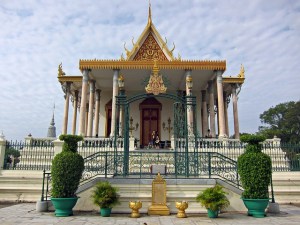
The photo below was taken outside the Silver Pagoda. It was a wonderful, cloudy morning. Not too hot and the sunlight was not harsh; perfect for photography.

Silver Pagoda

Royal Palace

The Royal Palace in Phnom Penh, Cambodia, has been the residence of the king of Cambodia since 1866, with a period of absence during the reign of the Khmer Rouge. One prominent building in the complex was the Throne Hall. This building was used only for important ceremonies like the king’s coronation or royal weddings. Behind the Throne Hall, there was a building behind a closed off and guarded gate. The building was the Khemarin Palace, the official residence of the king of Cambodia, King Norodom Sihamoni. Aside from these two buildings, there were a couple of buildings that were open air pavilions where traditional dance performances were performed, and there were several other closed-off buildings that seemed to be used for offices. On the south side of the Royal Palace complex, there was a long wall decorated with Ramaketi (the Khmer version of the Hindu epic Ramayana) frescoes, several large stupas commemorating past Cambodian royalties, and the royal temple known as the Silver Pagoda. The whole set up was very much similar to the Grand Palace in Bangkok, Thailand.

We visited the Royal Palace as our first destination during our full day visit to Phnom Penh. When we arrived there, we just had to purchase the entrance ticket, and then just walked into the complex to visit areas that are open for the public. It wasn’t as crowded as the Grand Palace in Bangkok. Inside the complex we could walk around and check out the interior of some of the buildings, but many were closed off. Unlike the Grand Palace in Bangkok that is used for ceremonies but is not the actual residence of the King of Siam anymore, the Royal Palace in Phnom Penh is actually the residence of the King of Cambodia, King Norodom Sihamoni. So we could observe a closed area with armed guards watching the entrance gate. Many visitors came with tour guides (they are easily recognizable because official tour guides in Cambodia had to wear uniforms when they’re on duty). We didn’t have one, so we just had to rely on our own guidebooks and the pamphlet handed out at the ticket booth. The palace is not as glitzy as the Grand Palace in Bangkok, but it’s still showing the dignity of the people of Cambodia, and provided some reminder of the past glory of the Khmer Empire.

The photo below was taken inside the complex. This was the Moonlight Pavilion that can also be seen from outside the complex. This particular pavilion has a balcony where the King can stand and watch One of the most notable buildings in the palace complex as it’s easily seen from outside. This pavilion had a balcony where the king could see parade passing by the boulevard outside the palace.

Moonlight Pavilion

Phnom Penh

Phnom Penh is the capital city and the largest city by population in Cambodia. Situated on the banks of the Mekong River, Phnom Penh has been a capital city since the time when Cambodia was a French colony. During the 1920s, Phnom Penh was known as ‘the Pearl of Asia’ with its many French colonial buildings and boulevards. Similar to Bangkok, the city is also the site for the Royal Palace for the Kingdom of Cambodia. The Royal Palace complex includes the Silver Pagoda, a temple covered with silver tiles and now houses many precious Buddha statues that are the national treasure of the Kingdom.

The city went through a dark period in its history during the Vietnam War, as it was used as a base by the many sides involved in the conflict (Northern Vietnamese / the Viet Cong, then the South Vietnamese and its allies, and later the Khmer Rouge). The darkest part of its history was when it fell under the Khmer Rouge regime in 1975. Most of its population of 3 million people at that time was ‘evacuated’ out to the Cambodian country side by the Khmer Rouge, and one of the city’s public schools was turned into a prison called S-21 or Tuol Sleng. During the four years that the Khmer Rouge was in power, 21,000 people were imprisoned there, and only seven came out alive. Many were taken and killed in a place outside Phnom Penh called Choeung Ek (aka The Killing Fields).

When we were planning our trip in Southeast Asia, one of the places we wanted to visit was the Angkor Wat, which is located near Siem Reap. We were not thinking about going to Phnom Penh, until I started reading about the history of Cambodia. If the Angkor Wat represents the highest point in the history of the Khmer people, the Khmer Rouge genocide represents the lowest point. The reality is that both of these were parts of the history that made the people who they are and where they are now. So we thought visiting only Siem Reap and Angkor Wat would not give us a complete picture if we really wanted to appreciate this country and its people.

So we decided to spend our first couple of days in Cambodia in Phnom Penh, and we specifically planned to visit sites that would give us a good overview of Cambodian history: the Palace and the Silver Pagoda, the National Museum of History, the Tuol Sleng Genocide Museum, and the Choeung Ek Killing Fields. I had never been to any ‘dark tourism’ sites like concentration camps or even Holocaust Museums, so I didn’t have anything to compare this to as preparation. What I did know was that this one day in Phnom Penh could be the most emotionally exhausting day of our trip. But I thought it was essential to do it so we get better understanding about what the people of Cambodia had gone through in the last few decades.

The photo below was taken from the passenger seat of our hired car on the way from the Phnom Penh International Airport a little outside of the city to our hotel inside the city. The drive through the outskirt of Phnom Penh felt like driving through a provincial town in Indonesia. You could tell that new, modern influences had started to come in, but it was largely looking like what Bangkok or Jakarta would look like 20 years ago.

Driving through Phnom Penh

Jim Thompson House

After our whole day full of activities in Bangkok, on the following day we had the morning time to do one last activity before we have to head to the airport to continue our journey. We decided to visit the Jim Thompson’s House Museum, which was easily reachable from our hotel by SkyTrain.

Jim Thompson was an American ex-pat who came to Thailand when he worked for the CIA. He ended up staying in Thailand and building a business empire selling Thai silk products. In the early 1960s, when he was in Malaysia for vacation, he disappeared and was never found. Today his house in Bangkok is a museum as a tribute to his life and his art collection.

The visit to the Jim Thompson House included a tour of the interior of his house. We were not allowed to take photos inside, but it was interesting to learn about some traditional features of Thai homes that were incorporated into the house. Things like having the home elevated to deal with possibility of flooding, and having a board to cover the bottom part of an entrance — believed to help prevent bad spirits to enter the home because there is a belief that the spirits travel on the floor surface. The home was a nice, cool oasis from the hot and humid day in Bangkok. It was not air-conditioned but it had very nice air flow throughout the house. It reminded me to some old homes in Indonesia.

Another interesting aspect that was similar to tradition in Indonesia was the rule to take off our footwear before entering the home. The Thai believes in keeping the house clean, so we were supposed to leave the dirty/dusty footwear outside and enter the house barefooted. It was interesting that within our tour group there were a couple of westerners who apparently didn’t feel comfortable with that rule, and they decided to just forego the tour and left.

The photo below was taken at from the gravel entry way outside the home. This is where visitors wait for their house tour to start.

Jim Thompson House