National World War II Memorial

The National World War II Memorial is located at the National Mall in Washington, DC, in between the Washington Monument and the Reflection Pool. This memorial was dedicated to the US soldiers who served in World War II. The memorial consists of 56 pillars representing the US states and territories, and two arches representing the two theaters where the war was fought, Atlantic and Pacific. There is also the Freedom Wall with 4,048 stars, each representing 100 US soldiers who died during the World War II.

The memorial is quite beautiful to see both during the day and at night. At night it’s quite nice to see the monument lighted, especially with the Lincoln Memorial and the Washington Monument nearby also lighted, and usually there are less people at night compared to during the daytime.

The photo below was taken at night when I went to the National Mall specifically to take photos at night. This was taken with very slow speed and narrow aperture to take on the lights at the right level and to have the beautiful water fountains flowing smoothly.

National World War II Memorial

Korean War Veterans Memorial

The Korean War Veterans Memorial is located in the National Mall area in Washington, DC, not far from the Lincoln Memorial and the Reflection Pool. This memorial was constructed to remember the US and United Nation soldiers who died or were missing in action during the Korean War in 1950-1953. The memorial includes 19 figures of soldiers representing all branches of the armed forces, depicted as a patrol squad on duty on a rugged Korean terrain, a granite wall with more than 2,500 photographic archival images of troops etched, and a shallow pool called the Pool of Remembrance with inscription listing the number of casualties from the war.

I’ve visited this memorial both during the day and at night. It’s pretty cool to see these soldier figures that looked quite realistic. At night, when these figures were lighted dimly, it looked like you’re looking at ghostly figures (since the soldier figures were light-colored stainless steel, and they were depicted as wearing raincoats).

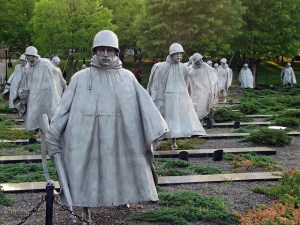
The photo below was taken during a visit in an afternoon. You can see the realistic look of the soldier’s face, and the other soldier figures in the background forming a patrol squad.

Korean War Veterans Memorial

Vietnam Veterans Memorial

The Vietnam Veterans Memorial is located at the National Mall area in Washington, DC, near the Lincoln Memorial. This memorial was created to remember the US armed forces service members who died in Vietnam/Southeast Asia and those who were Missing in Action during the War. The memorial was designed by architect Maya Lin, who won the design competition as a 21-year old Yale University student. The design was a source of controversy given its unconventional design. But over the time, people came to appreciate the beauty of its simplicity and emotional power of seeing the wall with names of those perished and missing.

I think the most moving part of this memorial is not only seeing the list of names of soldiers who perished during the War, but often times observing visitors coming to visit to look for a specific name of someone they know, and also seeing pictures, notes, letters, and other item left at the wall to remember someone.

The photo below was taken during a visit one weekend last summer. There were many people there, including a group of veterans, some in wheelchairs, coming to visit the memorial. There were also groups of young students who only learned about the Vietnam War from history books. As I saw one of the wall panels closely, I saw a reflection of the other side of the wall with visitors observing the wall, the Washington Monument and blue sky in the background, and an older gentleman observing the wall on the left corner, and the names etched on the wall. It made for a unique perspective to capture a scenery at this memorial.

Names on the wall at Vietnam Veterans Memorial

National Folk Museum

After walking the grounds of the Gyeongbokgung Palace, our Seoul City Tour group continued with a visit to the National Folk Museum of Korea. The museum is located right next door from the Gyeongbokgung Palace. The museum has artifacts that illustrate the history and traditional life in Korea. It reminded me somewhat to the American History Museum in Washington, DC.

Our visit to this museum was quite brief. I did see artifacts like traditional clothes, musical instruments, games, etc. and also some depiction of traditional practices within the Korean culture. But similar to other museums, you would be able to get more out of the visit if you’re willing to spend more time to really go through the exhibits.

The photo below was taken outside the museum. I noticed this group of Korean schoolboys in their uniform. It looked like they’re enjoying their visit to the museum, though I’m not sure at their age if they really appreciated what they saw at the museum. It reminded me to my own experience visiting museums in school trips when I was young; I was more excited about missing classes and going on the trip with my friends than about learning from the visit to these places. I guess it’s probably the same in any culture or country; you could see similar scene at the National Mall in Washington, DC, or at the National Museum in Indonesia.

Schoolboys at the National Folk Museum

Gyeongbokgung Palace

The first place we visited during the Seoul City Tour was the Gyeongbokgung Palace. The palace is located in the northern part of Seoul. It was first constructed in the 14th century and reconstructed in the 19th century, and it was once the residence of the royal family. The palace complex was nearly destroyed by the Japanese in the early 20th century; the buildings are slowly being restored and as of 2009 nearly 40 percent of the original palace buildings still stood or had been reconstructed.

During my visit to the palace, we first saw the changing of the guard ceremony at the Gwanghwamun, the main entrance to the palace. After entering the palace, we spent time touring around and visited many buildings that made up the palace. Our tour guide provided us with some explanations of the functions of the various buildings inside the palace.

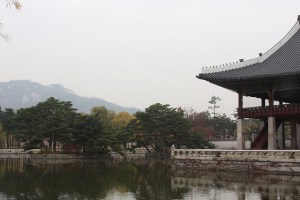
The building in the photo below is the Gyeonghoeru Pavilion. It is the Royal Banquet Hall that with a pond and landscaping around looked quite nice especially in the autumn.

Gyeonghoeru Pavilion