False Start

Few days ago I wrote about being out of my comfort zone when traveling to a foreign country. This feeling continued on to the second day of our visit in Phnom Penh, Cambodia, as we were totally dependent on logistical arrangements made online with a travel agency located in a city few hours away. My fear of logistical problem did materialize, but in the process we experienced the hospitality of the locals and we tried out tasty local foods. So here is the story…

We got up very early on our full day in Phnom Penh. The tour company that organized our trip in Cambodia had arranged to have a driver coming to pick us up for the day at the hotel at 7 am in the morning. Other than the time, I did not have any other details about the pick up, so I decided to be ready and wait in the lobby few minutes before the scheduled pick up time to make sure that the driver would not miss us.

I was ready to go and went down to the front area of the hotel by 6:40 am. It was still pretty early for the hotel operation. The restaurant was not open yet, and the front desk staff had not arrived either. There were a couple of the hotel staff members at the restaurant setting up the area to start the day, and another hotel staff cleaning the swimming pool area.

7 a.m. — and there was no one coming. I continued waiting for 15 more minutes, and still no one showed up. I started to get concerned, and walked to the street outside to check out, and walked back in. The hotel staff member who was cleaning the swimming pool area noticed that, and asked me if I was waiting or looking for anyone. I told him that we’re supposed to be picked up at 7, but our ride had not arrived yet. I asked him to help watching the front entrance, and to let me know if he saw anyone coming to look for me.

7:30 a.m. — and still there was no driver. By this time I was getting very concerned, so I looked for contact information for the tour company to call. The tour company was based in Siem Reap, and it was still quite early in the morning, so I was not sure whether I would be able to get hold of anyone. I tried calling using my Blackberry which should work in Cambodia (using Indonesian SIM card), but I had difficulty with making the call. So I went to the hotel front desk to get assistance. The front desk staff had just arrived and was in the middle of preparing for the day. When she saw me coming, she stopped her work and helped me dial the tour company’s number. She was very helpful especially in making the initial connection in Khmer before handing the phone to me when she was able to connect me with the tour company contact person.

Fortunately the tour company contact was there to answer our call, and after a few minutes he found out that there was a miscommunication with the driver they arranged for us in Phnom Penh about the start time. Typically day trips in Phnom Penh start at 8 am because the typical first destination, the Royal Palace, was not open until 8 am anyway. Our tour agent changed the start time for our day to 7 am when I told him that we also wanted to visit the Choeung Ek Killing Fields, which was located outside Phnom Penh. Apparently that wasn’t communicated clearly with the driver. Our tour company contact apologized profusely for this mishap, and said that the driver was on the way to pick us up. I told him not to worry; the important thing was that we knew that the driver was coming.

While waiting for our ride to arrive, I saw the hotel staff that I talked with earlier going to the front gate and stopping a food cart that was passing by. He ordered something – breakfast I guess. We had not had breakfast, and the hotel’s restaurant was still closed, so I went outside and asked the hotel staff what it was that he ordered. He said it’s a typical Cambodian sandwich. It looked pretty good, so I asked him to help me order two of those sandwiches for me and Kristi. He helped me translating between Khmer and English as I attempted to communicate with the food cart vendor.

We had the breakfast sandwich (later on I learned it is called num pang sandwich, very similar to Vietnamese banh mi sandwich), and not long after that a gentleman showed up at the gate, looked around, and when he saw me, he mentioned my name. He also apologized for picking us up late, and I told him it was okay. We started later than planned, but in the midst of the mishap, we experienced local hospitality and had delicious local sandwich for breakfast.

The photo below was taken right outside our hotel as I waited for the sandwich man prepared our num pang sandwich.

Num pang sandwich cart

Malis

Malis is an upscale restaurant in Phnom Penh, Cambodia, that serves authentic Cambodian dishes. The restaurant’s Head Chef, Luu Meng is a celebrated and award winning chef in Cambodia. In the episode of Samantha Brown’s Asia where she visited Phnom Penh, there was a segment where she went to Malis and talked with Luu Meng about how he was from a family of chefs, but the creativity and tradition with the Khmer cuisine was suppressed during the Khmer Rouge era, and now he’s bringing those back through Malis and his other ventures.

We went to Malis on our first night in Phnom Penh. We found Malis on the list in my Lonely Planet Cambodia guidebook. It had pretty good note as having authentic Cambodian cuisine, and the location was not far from our hotel. The dinner was pretty good. We had a grilled chicken dish that tasted similar to an Indonesian dish, and a baked goby fish. The fish was fresh, and it was first salt crusted before being baked. The restaurant had a nice ambience and it’s a good place to dine for special occasion. The price was comparable to dinner for two in the United States — which means it was actually expensive for Cambodian standard. The majority of the patrons were foreigners. I wonder if Cambodians would actually go to this restaurant — I’m guessing they probably know cheaper alternatives that probably serve food as good as in this restaurant but it might not be as high profile or has the nice ambience.

The photo below was taken as we started digging through our meal. Here was Kristi and the big plates with the two dishes we ordered. Notice how big the fish was; it was brought out whole and our waitress fillet it at the table for us.

Dinner at Malis

Money Matters

One thing important to learn before traveling to a foreign country is about the local customs when dealing with monetary matters. Things like currency used, preferred method of payment, gratuity expectations, sales tax, customs, etc. To learn about these, you could start with reading travel guides like Lonely Planet’s, Fodor’s, National Geographic Travelers, etc. which very likely have sections that discuss this topic. The important thing to note is to not assume that your normal way of conducting transaction at home is accepted the same way in the country you’re visiting. For example, in the United States using credit cards and sometimes even personal checks are acceptable as methods of payment when you go to stores. You take the same credit card to a foreign country, it may not be accepted there because the local merchants may be more used with cash payment, and even if they have credit card as an optional method of payment, it’s actually not preferred because of the extra cost that has to be paid to the credit card company for the convenience. Another thing to check with credit cards is whether there is foreign transaction fee charged every time you use your credit card for transaction outside your home country — this could amount to as much as 3-5% of the transaction amount.

When we went to Cambodia, we already had the travel logistics (hotels, transportation, and tour guide) arranged in advance, so by the time we arrived in Phnom Penh, we didn’t think much about the money aspects. The first time we had to think about this however was very shortly after our arrival. We had a driver with a car hired by our tour company coming to pick us up at the airport to take us to our hotel. The actual car pick up was already paid for through the tour company, but then during the ride Kristi and I had a discussion on gratuity for the driver. We were trying to figure out what was acceptable to give as gratuity once we arrive to the hotel. On one hand, I remembered reading in a guidebook that gratuity was not part of what’s expected in the culture, but lately with more foreign tourists coming to Cambodia, it became more widely expected. On the other hand, I wasn’t sure what would be the proper amount to give that wouldn’t be considered as insulting if it’s too low, or too much. We also didn’t know how much the actual cost for the car pick-up from the airport. As far as currency, I knew that US dollars were widely accepted as currency; the problem was that I only had a $5 bill and the rest of the USD cash we carried were of larger denominations ($20 and $100). So it would be kind of awkward giving a large bill and asking for change to return when giving gratuity. I finally just gave the $5 to the driver as a tip. I think that turned out to be pretty good amount, and he seemed to be pretty happy to receive it, so we felt good with that decision.

Later on I asked our hotel front desk about public transportation to get around the city, and they suggested the best way to get around is to take one of the tuk-tuks (or also known as remorque) from outside the hotel. There was usually at least one of these tuk-tuk drivers waiting there to take hotel guests elsewhere. They said you need to bargain with the tuk-tuk driver, but typically you can get about anywhere within Phnom Penh from the hotel for $2.

When we were ready to go to a restaurant we selected from the guidebook for dinner, we went outside the hotel and we were met by one of these tuk-tuk drivers who offered his service. I showed him the name and address of the restaurant; he nodded his head and motioned to us to get into the passenger seat of his tuk-tuk. We followed that, and off we went… Then few minutes later, Kristi asked me about the pricing… oops, it happened so fast, I forgot that we were supposed to ask for the expected price and bargain first with the driver before agreeing to go with him.

We ended up getting to the restaurant, and the tuk-tuk driver asked me if we wanted him to come back again later to pick us up and bring us back to the hotel. I said yes, and before I had a chance to talk about the pricing, he said he’ll be back in two hours, and we can pay him later when we get back to our hotel.

Two hours later, after we finished our dinner, we went outside the restaurant, and sure enough, the tuk-tuk was waiting for us to bring us back to the hotel. We got back to the hotel, and I asked the driver how much the ride was. He said $5. Remembering what the hotel staff said, I said, no, it should be $4. He smiled and said okay. But then I thought, you know it’s only $1 difference, not much from my perspective, but in a country where in 2010 the GDP per capita was $810 (compared to $47,000 in the United States), $1 probably made a big difference to this driver. So I ended up giving him $5 and letting him keep the extra $1.

I think that’s one aspect that is somewhat up for discussion among foreign visitors from wealthier countries… do you tip or not, and how much do you bargain. You don’t want to be taken advantage of, but at the same time, I think you don’t want to be carried away with the bargaining part. I feel that in the end it’s better to be more generous to the locals especially if they did provide good service and you have the means to give extra. You never know how much of a blessing that could be for those who receive it, and sometimes it doesn’t take much to do that.

The photo below was taken from the passenger seat during that tuk-tuk ride to the restaurant, as we took in the night scenery around and familiarized ourselves with the area close to our hotel.

Tuk-tuk ride

The 252

The 252 is a boutique hotel in downtown Phnom Penh, Cambodia. The hotel is owned and run by French/Swiss managers, but purposefully they tried to put some touch of Khmer tradition in the decor, so the hotel and its rooms were quite nicely decorated with a mix of modern and traditional interior design. The hotel is located on the 252nd street in Phnom Penh (thus the name of the hotel). It’s located a bit further out from many of the tourist hotels that are located closer to the Sisowath Quay (the area near the river that’s popular with tourists — similar to Khao San Road in Bangkok, Thailand), but it’s close enough that you can just take tuk-tuk for about USD $2 to get there or pretty much all major tourist attractions in the city.

We found out about The 252 when we looked for hotel to stay at in Phnom Penh on TripAdvisor. The 252 was ranked pretty high for hotels in Phnom Penh, and many reviewers gave it nice comments about their stay there. In some cases where there were complaints or negative experience, the hotel management actually provided response — I thought that was nice that they actually cared about the feedback/reviews that people gave. The price for the room was a bit higher than some others that we also looked at, but it was still quite reasonable.

When we arrived at The 252, the first thing we noticed was that the hotel was somewhat low key and hidden behind tall walls from outside. When we opened the front gate and came in, we saw immediately the pool with chairs around and the shaded outdoor seating for the hotel’s restaurant. It’s a nice, somewhat secluded oasis in there, quite a contrast from the hustle and bustle of the city you just right outside its wall.

Our room was one of the 19 rooms the hotel had, and we were situated on the third floor of the hotel. It was a nicely-decorated room; somewhat minimalist in style. We had good night sleep for both of the nights we stayed there, though at times we could hear some noise of construction or simply daily life going on in the neighborhood. They tried to block those with their walls, but we’re right in the middle of an urban city, so I don’t think it’s avoidable. In the morning, we also could smell Khmer cooking from a nearby kitchen — I wasn’t sure if it was the hotel’s kitchen or their neighbors. It gave a unique feel of staying in urban Phnom Penh — though some visitors looking for total isolation / seclusion may not be happy with it.

The hotel manager and staff were also very hospitable and helpful during our stay. When we arrived, we had a little problem using the TV and the safety box in our room. I went to the front desk to ask, and the manager actually went with us to our room to help us out. On the second day of our stay, we had a little mishap in our logistics to start the day. The hotel staff helped me contact our tour company to get things straighten out (we booked the two separately, so they didn’t have any relation to our tour itinerary). And on our last day, when we had to leave very early in the morning before the restaurant was open, they prepared carry-out breakfast for us the night before, so we could just come to the front desk and ask for our carry-out breakfast before we left. Overall, it was another excellent stay at a boutique hotel during this trip to Southeast Asia.

The photo below was taken from the seating area near the pool. You can see the nice pool with some seating areas around, and in the background you could see the high walls that completely block the view from the outside in and vice versa.

The 252

Out of Comfort Zone

It’s interesting to note how traveling to a foreign country could make even a seasoned traveler feel out of his/her comfort zone. If you take away things that one normally relies on to be independent — guides, maps, and language (the ability to communicate), suddenly a normally confident traveler could lose his/her ability to navigate and would really feel helpless.

Such was how I felt when we were driving from the Phnom Penh International Airport to our hotel during our arrival in Phnom Penh, Cambodia. Fortunately we had arranged transportation through a tour company, who sent a driver and a car to pick us up at the airport and take us to our hotel. One little concern — the driver only spoke a little English. He had a board with my name and the tour company name written on it when we spotted him as we came out from the baggage claim area, and I just pointed to the name and pointed to myself to indicate that we’re the passengers he’s picking up. We followed him to his car, got our luggage loaded into the trunk, and off we went to our hotel. We tried to engage him in conversation in English, but he could barely understand what we’re saying though he tried to communicate with us with the little English he knew. We decided to not continue that so he didn’t feel bad for not being able to engage us in conversation.

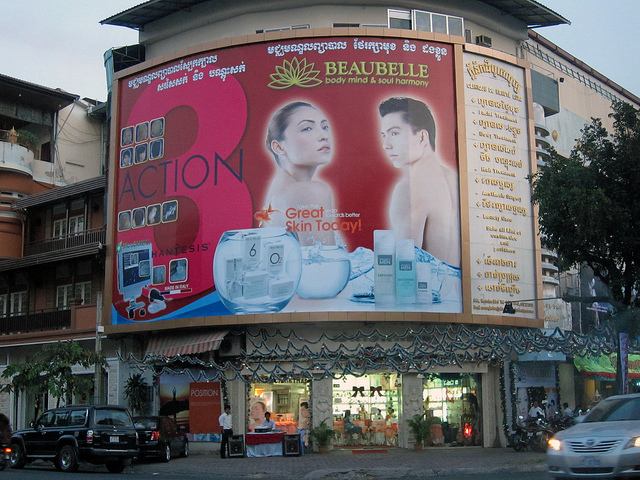
As we drove towards downtown Phnom Penh, the surroundings were very different compared to what we saw when we were in Bangkok. In Bangkok, we rode the taxi from the airport on a big toll road that had signs in English and Thai, so we could roughly figure out where we’re going. In Phnom Penh, we were driving through somewhat urban area, and if there were signs at stores or commercial buildings, they were mostly in Khmer script, which I couldn’t recognize at all. I also didn’t have a map that could help me get the bearing of where we’re going.

That’s when I realized how helpless I felt at that moment — we’re hoping that our driver knew exactly where we’re supposed to go; we completely relied on him having the right instruction/information from the tour company. It’s interesting to compare that to my typical experience traveling in the United States. I used to travel very frequently for work to many cities in the US, but even in a new city that I had never visited before, the routine was roughly the same: find the sign at the airport for ground transportation, head towards the rental car company, pick up a car, and either use directions printed out from Google Map or use a GPS to navigate myself to my destination. When I didn’t have the normal things I usually relied on, suddenly I really felt out of my comfort zone as a traveler.

It all ended up well — our driver indeed took us to the right place. I’m so glad we had this pick up arranged; otherwise it might’ve made an interesting adventure getting from the airport to our hotel.

The photo below was taken during that drive, as we passed a local store that seemed to sell beauty products. Note the writing in Khmer scripts. I had a guidebook on my Kindle that provided translation from English to Khmer and vice versa, but since I’m not used to the script used in Khmer, those squiggly lines looked all the same to me and I couldn’t really determine what they might mean.

Store in Phnom Penh