The World’s Best Known Roadside Sculpture

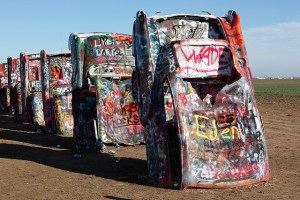
Few miles west outside the city of Amarillo, Texas, on Interstate 40, if you pay attention on south side of the road, you can see an interesting artwork in the middle of the field. It’s the Cadillac Ranch, a sculpture built as a tribute to one of the most iconic American cars. In 1974, a group of artists called the Ant Farms built this ‘sculpture’ by taking ten Cadillac automobiles ranging from 1949 to 1963 models and burying them halfway into the ground nose first. A local millionaire named Stanley Marsh 3 let the artists built the sculpture on his land. In 1997, the sculpture was moved about 2 miles away to where it is located today to accomododate the growth of the city of Amarillo. Today the sculpture still remains there on the side of the Interstate, and anyone is welcomed to stop by and check out the sculpture. In addition, writing graffiti on the cars with spray paint is also encouraged, so you would surely see something different when you visit it at different time.

This was one of the landmarks that we thought we should try to find and see in person during our coast-to-coast road trip. But spotting it was not easy as we had never been there before and we had been driving for quite a while since we left Santa Fe, NM, with a brief stop in Tucumcari. We also wanted to make sure we get there before it gets dark.

As we got closer to Amarillo, I asked my brother to look to the side of the road for any sign of the sculpture. Finally we saw several cars parked on the side of the frontage road on the side of the Interstate highway. In a distance, we saw the 10 Cadillac cars that made up the Cadillac Ranch. We found the nearest exit and parked our car on the road side, and went through the unlocked gate into the pasture and joined several other people who were also checking out the sculpture.

While we were there admiring this unique artwork, we saw a group of people coming. It looked like a wedding party as we saw many of them dressed up, and sure enough the bride and groom came not long after. They came there to do some photoshoot near the sculpture. Quite an interesting location for a wedding photoshoot. I suppose beauty is in the eyes of the beholder, and those seeing the photos would surely identify the place as something unique to Amarillo. Yet another quirky find on Route 66.
Cadillac Ranch

The Big T and Colorful Signs

Tucumcari is a small town in northeastern New Mexico. It is located along the modern day Interstate 40 and the historic Route 66. The town is the first town of significance in New Mexico if you’re driving west bound from Texas. For the Route 66 enthusiasts, the town is a higlight of any road trip as there are many businesses along the main road through the town that have colorful neon signs outside the stores. The town is often considered as among the best representation of what Route 66 was like in its heyday with many stores and motels along the way that provide unique merchandise or services to the travelers on the route.

I first learned about Tucumcari when I was researching Route 66 before the road trip. There were several Route 66 landmarks in Tucumcari that many suggested to look for, such as the Tepee Curios shop that had an entrance shaped like — you guessed it — a tepee, and the Blue Swallow Motel, a local motel with a neon sign outside that had been photographed in many Route 66 literature. These landmarks were among the many that served as inspirations when the Pixar animators created the fictional town of Radiator Springs in the movie Cars. There was also a big T sign on the Tucumcari Mountain that can be seen from the Interstate highway as well as from the town. This was the inspiration for similar vista behind Radiator Springs in the movie (with the big with RS on the side of the mountain).

We reached Tucumcari after a few hours drive from Santa Fe. I remembered the drive on Interstate 40 prior to reaching Tucumcari because, well, I didn’t want to remember it. It was driving on a long stretch of very straight highway that seemed to continue forever to the horizon, and the sun was shining through the windshield and it got really warm after a while at the front seat. The combination of warm and somewhat boring ride meant I had a challenging time to keep myself from falling asleep. So it was quite a nice relief reaching Tucumcari and stopping at a local gas station to fuel up and freshen up with some nice cold drinks. I suppose that’s part of the experience of doing such road trip. The sight of a town with a gas station selling fuel for both the car and the passengers, as well as options to stop for a meal, shopping souvenirs, or even staying overnight are quite welcomed by the travelers. And for the locals, they welcomed the travelers as to some, these were the main source of income.

Aside for taking photos of some of the landmarks that we passed on the drive, we ended up just continuing our drive to our next destination. I thought that brief drive and visit through this small town really drove the point about the impact of the Interstate Highway on the livelihood of towns that were previously dependent on being on the Mother Road. I’m glad we took the little ‘detour’ to exit the Interstate highway to see the town, rather than just driving pass it on the Interstate like most of the modern travelers do.

Below is a photo of the Tepee Curios shop, one of the landmark businesses on Route 66 in Tucumcari. It was like a scavenger hunt driving through the town and looking left and right for these landmarks that we read in the guidebooks.

Tepee Curios

Miraculous Staircase

The Loretto Chapel is a chapel of a former parochial school run by the Sisters of Loretto in Santa Fe, New Mexico. It is famous for its unusual spiral staircase. The building was constructed in 1853. During the construction of the building, they noticed that there was an oversight in the planning that the staircase needed to get to the choir loft was not in the plan. The size of the building was too small to put a normal size staircase. The story has it that the nuns prayed for St. Joseph’s intercession in nine days, and then a stranger showed up and told the nuns that he could help them build a staircase for the chapel provided that he was given privacy to work on it for three months. So he locked himself in the chapel and worked on the staircase, and when he was done he dissappeared. The nuns offered reward to find the carpenter, but it was never claimed. Many who saw the resulting staircase thought that it might be St. Joseph himself who came and helped built the staircase.

Aside from the mysterious person who worked on the staircase, the part that many considered as miraculous was the fact that the staircase was constructed without the use of nails and it does not have a central pole to support it. When studies were done to learn more about the structure, they learned that the outer helix combined with small radius of the inner wood stringer provided the structural support for the staircase.

Regardless whether it was a miracle or not, in the end the nuns had their prayers answered and they ended up with a beautiful staircase for their chapel. The staircase is a wonderful work of art that is worth checking out when you are in the area. We visited the chapel briefly during our stop in Santa Fe. Though it felt a little bit like it’s a tourist trap with many other tourists lining up to come into the small chapel, the visit was worthwhile as we got to see not only the staircase but also the beautiful interior of the chapel itself.

Miraculous staircase

Through the Eyes of an Artist

The area near Santa Fe, NM, is often called the “Georgia O’Keeffe Country” because the famous American painter spent a significant part of her life in the area and took the natural vistas and unique cultural influences as the inspiration for her work.

Prior to coming to Santa Fe, I didnt’ really know much about Georgia O’Keeffe other than she was a very well-known American artist and she called New Mexico home. We went to the Georgia O’Keeffe Museum in Santa Fe to learn more about her life and works. There we learned about her long life and career, her association with some other well-known American artists (like her husband Alfred Stieglitz, a world-famous photographer), and seeing a sampling of her works. The one that I recognized immediately was her painting of a ram’s skull with its two horns; an object unique to the area that she probably found somewhere in the nearby land.

As I read more about her life and approach to her arts, I learned that Georgia O’Keeffe was recognized for her approach to art that didn’t necessarily take influence from others. She was trained at the Art Institute in Chicago, and spent some time with her husband living in New York City, but it seemed that being alone in a small village in New Mexico provided her with more inspiration for her art work. She was able to take the time to explore and observe the unique landscape and nature around her, and came up with works that represented her view of those. Though she had some paintings of New Mexico landscapes, there were more paintings focusing on objects and close up view of nature she found around her — skulls or bones, flowers, architectural shapes, etc. And some were abstract in nature, not exactly photo-realistic replica of the real object but representing her view of it.

Sometimes when seeing artwork, I didn’t quite understand what the artwork really meant or where the artist got his or her inspiration from. But seeing some of O’Keeffe’s work, I could see how she appreciated seeing the details of things and life around them and appreciate those and captured them in her paintings. I appreciated this more as I thought of my own experience when I took my camera out and look for things to photograph. Sometimes the beauty and interesting things are found even in the seemingly ordinary surroundings when you take the camera and aim the viewfinder at details that normally we overlook. It could be shapes, combination of colors, textures, patterns, or any of these factors that our mind can appreciate as something beautiful or interesting.

Another observation from visiting the Museum and reading articles of Georgia O’Keeffe was that pretty much in all of the portrait photos of her that I saw, she seemed to have an austere look. I’m not sure if that’s more of a cultural norm or it was really her personality, but it seemed like she was always in deep thinking about things she observed, perhaps only expressed things through her arts.

Our visit to the Georgia O’Keeffe Museum was quite brief; we only spent less than a couple of hours there as the place was quickly filled with visitors. But just like she went out and took time to look at details that others might have overlooked when rushed through the busyness of life, I wonder if we could appreciate her work and her perspective of the world around her more if perhaps we took time to go around the surrounding area and experience the nature that became her inspiration for her works.

Georgia O'Keeffe

Santa Fe

Santa Fe is the capital city of the state of New Mexico. The city is rich in history, as it started as an ancient settlement of the Pueblo Indians as early as 1050 and 1150, then becoming a Spanish colony around the 1600s, being part of the Republic of Texas briefly in the early 1800s, and then from 1912 becoming the state capital when New Mexico became a US state. The city is quite unique as they impose an ordinance as part of city planning that requires any building built in the city to follow a distinct architectural style (the Spanish revival style). The city also attracts artists given the beauty of the landscape of the surrounding mountains and deserts. You can find a large number of galleries within the city center. In mid 20th century, with the Los Alamos National Laboratory and Sandia National Laboratory opened up nearby, there is also significant scientific community residing in the area.

The early alignment of Route 66 (before 1937) went through Santa Fe, so today most guide for Route 66 travel would include the city in its route coverage. When we’re planning for our trip, we thought of taking a shortcut and continuing on Interstate 40 east bound and not going out of the way (north of Albuquerque) to Santa Fe. However, we thought it’s such a rich place historically and culturally to miss that it’s worth taking the extra time for the detour to at least spend a few hours there. To ensure we could still stay within our trip timeline, we decided to leave our rest stop the night before at a very early hour. Combined with our late arrival the night before, this meant we only had less than four hours of sleep before having to continue again. My brother and I took turn in driving and getting a bit more sleep in the car during the drive from Holbrook, AZ, to Santa Fe.

We arrived at Santa Fe around 9 am, just in time to find parking and head to one of the museums in town to spend a couple of hours checking it out. My brother is a visual artist, and if you think of visual arts and Santa Fe, the name that likely would come up is Georgia O’Keeffe, a famous American painter who spent significant time of her life near Santa Fe. There is a museum featuring her works in Santa Fe, so we decided to go there for our stop in the city.

We also spent some time walking around the downtown area of Santa Fe. It was early October time, so we could already feel the autumn weather with the crisp air and some of the aspen trees around already turning yellow. As we walked through a park in downtown Santa Fe, I noticed a gentleman (looked like either he was of Native American or Spanish descent) with his accoustic guitar playing some beautiful tunes at the park. I took the picture below, which I think is a good representation of Santa Fe with its arts, history, and culture.

Accoustic guitarist at the park