The 252

The 252 is a boutique hotel in downtown Phnom Penh, Cambodia. The hotel is owned and run by French/Swiss managers, but purposefully they tried to put some touch of Khmer tradition in the decor, so the hotel and its rooms were quite nicely decorated with a mix of modern and traditional interior design. The hotel is located on the 252nd street in Phnom Penh (thus the name of the hotel). It’s located a bit further out from many of the tourist hotels that are located closer to the Sisowath Quay (the area near the river that’s popular with tourists — similar to Khao San Road in Bangkok, Thailand), but it’s close enough that you can just take tuk-tuk for about USD $2 to get there or pretty much all major tourist attractions in the city.

We found out about The 252 when we looked for hotel to stay at in Phnom Penh on TripAdvisor. The 252 was ranked pretty high for hotels in Phnom Penh, and many reviewers gave it nice comments about their stay there. In some cases where there were complaints or negative experience, the hotel management actually provided response — I thought that was nice that they actually cared about the feedback/reviews that people gave. The price for the room was a bit higher than some others that we also looked at, but it was still quite reasonable.

When we arrived at The 252, the first thing we noticed was that the hotel was somewhat low key and hidden behind tall walls from outside. When we opened the front gate and came in, we saw immediately the pool with chairs around and the shaded outdoor seating for the hotel’s restaurant. It’s a nice, somewhat secluded oasis in there, quite a contrast from the hustle and bustle of the city you just right outside its wall.

Our room was one of the 19 rooms the hotel had, and we were situated on the third floor of the hotel. It was a nicely-decorated room; somewhat minimalist in style. We had good night sleep for both of the nights we stayed there, though at times we could hear some noise of construction or simply daily life going on in the neighborhood. They tried to block those with their walls, but we’re right in the middle of an urban city, so I don’t think it’s avoidable. In the morning, we also could smell Khmer cooking from a nearby kitchen — I wasn’t sure if it was the hotel’s kitchen or their neighbors. It gave a unique feel of staying in urban Phnom Penh — though some visitors looking for total isolation / seclusion may not be happy with it.

The hotel manager and staff were also very hospitable and helpful during our stay. When we arrived, we had a little problem using the TV and the safety box in our room. I went to the front desk to ask, and the manager actually went with us to our room to help us out. On the second day of our stay, we had a little mishap in our logistics to start the day. The hotel staff helped me contact our tour company to get things straighten out (we booked the two separately, so they didn’t have any relation to our tour itinerary). And on our last day, when we had to leave very early in the morning before the restaurant was open, they prepared carry-out breakfast for us the night before, so we could just come to the front desk and ask for our carry-out breakfast before we left. Overall, it was another excellent stay at a boutique hotel during this trip to Southeast Asia.

The photo below was taken from the seating area near the pool. You can see the nice pool with some seating areas around, and in the background you could see the high walls that completely block the view from the outside in and vice versa.

The 252

Out of Comfort Zone

It’s interesting to note how traveling to a foreign country could make even a seasoned traveler feel out of his/her comfort zone. If you take away things that one normally relies on to be independent — guides, maps, and language (the ability to communicate), suddenly a normally confident traveler could lose his/her ability to navigate and would really feel helpless.

Such was how I felt when we were driving from the Phnom Penh International Airport to our hotel during our arrival in Phnom Penh, Cambodia. Fortunately we had arranged transportation through a tour company, who sent a driver and a car to pick us up at the airport and take us to our hotel. One little concern — the driver only spoke a little English. He had a board with my name and the tour company name written on it when we spotted him as we came out from the baggage claim area, and I just pointed to the name and pointed to myself to indicate that we’re the passengers he’s picking up. We followed him to his car, got our luggage loaded into the trunk, and off we went to our hotel. We tried to engage him in conversation in English, but he could barely understand what we’re saying though he tried to communicate with us with the little English he knew. We decided to not continue that so he didn’t feel bad for not being able to engage us in conversation.

As we drove towards downtown Phnom Penh, the surroundings were very different compared to what we saw when we were in Bangkok. In Bangkok, we rode the taxi from the airport on a big toll road that had signs in English and Thai, so we could roughly figure out where we’re going. In Phnom Penh, we were driving through somewhat urban area, and if there were signs at stores or commercial buildings, they were mostly in Khmer script, which I couldn’t recognize at all. I also didn’t have a map that could help me get the bearing of where we’re going.

That’s when I realized how helpless I felt at that moment — we’re hoping that our driver knew exactly where we’re supposed to go; we completely relied on him having the right instruction/information from the tour company. It’s interesting to compare that to my typical experience traveling in the United States. I used to travel very frequently for work to many cities in the US, but even in a new city that I had never visited before, the routine was roughly the same: find the sign at the airport for ground transportation, head towards the rental car company, pick up a car, and either use directions printed out from Google Map or use a GPS to navigate myself to my destination. When I didn’t have the normal things I usually relied on, suddenly I really felt out of my comfort zone as a traveler.

It all ended up well — our driver indeed took us to the right place. I’m so glad we had this pick up arranged; otherwise it might’ve made an interesting adventure getting from the airport to our hotel.

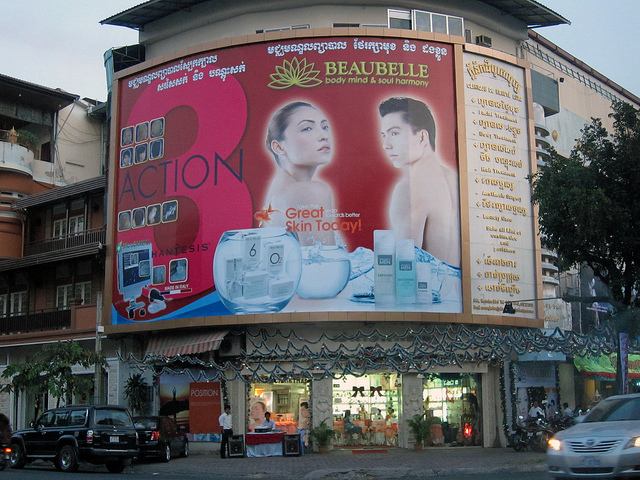
The photo below was taken during that drive, as we passed a local store that seemed to sell beauty products. Note the writing in Khmer scripts. I had a guidebook on my Kindle that provided translation from English to Khmer and vice versa, but since I’m not used to the script used in Khmer, those squiggly lines looked all the same to me and I couldn’t really determine what they might mean.

Store in Phnom Penh

Visa for Cambodia

Whenever you’re traveling to a foreign country, one of the important matters to figure out before the trip is whether you need to obtain a visa to visit the country. This regulation varies country by country, and also it depends on your country of citizenship as well. If you find out that a visa is required, you also need to figure out where to get the visa from and when you need to apply for it — in some countries, this might be a lengthy and involved process that you need to allow enough time in advance before your trip to ensure you have the visa before you go.

To visit Cambodia, most visitors would need to obtain visa from the Cambodian government. They actually have an online site that allows you to obtain the visa conveniently over the Internet. All you need is your valid passport, your digital photo, and a credit card. Very convenient — you just need to make sure you get it close enough to your trip date because the visa is only valid for three months after the issuance. Alternatively, you can also get the visa on arrival. You just need to bring some passport photos that they will collect when you apply for the visa upon your arrival in Cambodia.

When my cousin Kristi and I traveled to Cambodia, we arrived without having the visa already requested because some information we found online indicated that because we’re Indonesian citizens, we wouldn’t need to get visas because there is agreement between the Cambodian government and other ASEAN countries including Indonesia (we knew that was the case for the other countries we visited: Thailand, Vietnam, and Singapore). But we thought to be safe we should still take a couple of passport photos just in case we had incorrect information.

When we arrived in Phnom Penh, we followed other foreigners from our flight from Bangkok to go through the immigration area. Most people who were requesting visa on arrival went straight to the long line to submit their paperwork. We went towards an immigration officer to ask if we needed to get visas. His English wasn’t that good, but after looking at our passports, he pointed us towards the officer who would check the passport and register our visit. We proceeded to that line, only to find out that apparently at that time Indonesian citizens could come without visa, but only for diplomatic purposes, not for tourism. So we had to go back to the end of the line to request for visa on arrival. The process itself was pretty expedient, though it was interesting that after we submitted our passport, paperwork, and photos, they told us to proceed to the next window where everyone else waited, and one by one the officer would call out your name for you to pay and pick up your passport with the visa. So it was interesting to observe and listen to other people getting called out — by the end we kind of learned other passengers’ names…

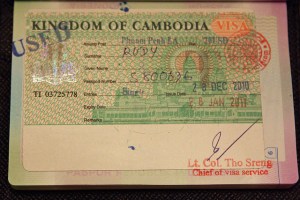
The photo below was the visa page of my passport after the visit. One thing that was interesting, the Cambodians typically write their names as [surname] [given name], in different order compared to typical Western names ([given name] [surname]). So when I got my passport back, the name written on the visa for me was my given name in the place where it’s supposed to be the surname.

Visa on arrival

Phnom Penh

Phnom Penh is the capital city and the largest city by population in Cambodia. Situated on the banks of the Mekong River, Phnom Penh has been a capital city since the time when Cambodia was a French colony. During the 1920s, Phnom Penh was known as ‘the Pearl of Asia’ with its many French colonial buildings and boulevards. Similar to Bangkok, the city is also the site for the Royal Palace for the Kingdom of Cambodia. The Royal Palace complex includes the Silver Pagoda, a temple covered with silver tiles and now houses many precious Buddha statues that are the national treasure of the Kingdom.

The city went through a dark period in its history during the Vietnam War, as it was used as a base by the many sides involved in the conflict (Northern Vietnamese / the Viet Cong, then the South Vietnamese and its allies, and later the Khmer Rouge). The darkest part of its history was when it fell under the Khmer Rouge regime in 1975. Most of its population of 3 million people at that time was ‘evacuated’ out to the Cambodian country side by the Khmer Rouge, and one of the city’s public schools was turned into a prison called S-21 or Tuol Sleng. During the four years that the Khmer Rouge was in power, 21,000 people were imprisoned there, and only seven came out alive. Many were taken and killed in a place outside Phnom Penh called Choeung Ek (aka The Killing Fields).

When we were planning our trip in Southeast Asia, one of the places we wanted to visit was the Angkor Wat, which is located near Siem Reap. We were not thinking about going to Phnom Penh, until I started reading about the history of Cambodia. If the Angkor Wat represents the highest point in the history of the Khmer people, the Khmer Rouge genocide represents the lowest point. The reality is that both of these were parts of the history that made the people who they are and where they are now. So we thought visiting only Siem Reap and Angkor Wat would not give us a complete picture if we really wanted to appreciate this country and its people.

So we decided to spend our first couple of days in Cambodia in Phnom Penh, and we specifically planned to visit sites that would give us a good overview of Cambodian history: the Palace and the Silver Pagoda, the National Museum of History, the Tuol Sleng Genocide Museum, and the Choeung Ek Killing Fields. I had never been to any ‘dark tourism’ sites like concentration camps or even Holocaust Museums, so I didn’t have anything to compare this to as preparation. What I did know was that this one day in Phnom Penh could be the most emotionally exhausting day of our trip. But I thought it was essential to do it so we get better understanding about what the people of Cambodia had gone through in the last few decades.

The photo below was taken from the passenger seat of our hired car on the way from the Phnom Penh International Airport a little outside of the city to our hotel inside the city. The drive through the outskirt of Phnom Penh felt like driving through a provincial town in Indonesia. You could tell that new, modern influences had started to come in, but it was largely looking like what Bangkok or Jakarta would look like 20 years ago.

Driving through Phnom Penh

AirAsia

AirAsia is the pioneer of regional low-cost airlines in Asia. The Malaysian-based company started taking off as a popular air carrier in the region around 2001, and now it is the largest low-cost airlines in Asia. In addition to their main hub in Kuala Lumpur, AirAsia also has a couple of subsidiaries, Thai AirAsia based out of Bangkok, Thailand, and Indonesia AirAsia based out of Jakarta, Indonesia. They currently provide routes that cover 400 destinations in 25 countries.

My first exposure to AirAsia was during my Southeast Asia trip last year. We were planning on visiting several countries and traveling independently, so low-cost airlines came up as considerations for the travel. Most of the travel segments were pretty short distance (less than four hours), so we didn’t care as much about special in-flight service or extra-comfort (which would be more of a factor if we were traveling long distance). The primary factors considered were safety record, timeliness, and cost. Anyone traveling in Southeast Asia region with these factors considered would include AirAsia as an option. We looked at AirAsia routes for the travel itinerary that we’re planning, and found that it would work for two of the segments (Bangkok – Phnom Penh, and Singapore – Jakarta), but not for the other segments. Primarily because of the scheduling and routing — you get the low cost by traveling AirAsia but you’re paying in terms of longer travel times or inconvenient departure times (some of the routes would require us to transit in Kuala Lumpur in the middle, so a direct flight that would take only 3 hours may end up to be a more than 8 hour-trip). It’s pretty similar to what you find in the US with low-cost airlines like Southwest Airlines. Great service and great price, but at times may be inconvenient travel itinerary.

One interesting planning fact I learned from my cousin Kristi who had used AirAsia to visit several destinations in the region is that you can get ridiculously low fare if you can and are willing to book the flight way in advance (up to one year in advance). They would have limited seats that were deep discounted (more than 75% off), but with condition that you have to do advance purchase, and it’s not refundable/exchangeable. In some cases, the price was low enough that some people would go ahead and purchase the tickets even if it might mean they couldn’t use it and would have to waste it.

Another interesting tip to know is that the price is low because there are many things that are offered as ala-carte options to purchase (like extra luggage weight and in-flight food service). Today many US carriers impose extra luggage fee and charging for in-flight food service, and that received negative feedback from the customers. I guess that’s because people are used to having those services as part of what they’re expecting from air travel that taking those away (or charging extra for those) naturally would cause negative reactions. With AirAsia and other low-cost carriers, the low expectation is set upfront as a consequence of getting the airfare at lower price, so then their customers can opt to pay more to get the extra convenience (e.g., for us we paid a little extra for luggage weight allowance so we didn’t have to worry about getting too close to the standard limit and getting penalized for overweight).

The actual travels on AirAsia were actually quite uneventful. It was interesting to observe that when we checked in, instead of given the boarding pass in the typical ticket-size print outs, ours looked more like a grocery/store receipts. I guess either way it has barcode so it doesn’t really matter — and they don’t have to get specialized printers to print those.

Both our Bangkok – Phnom Penh and Singapore – Jakarta trips left and arrived on-time. The flights were quite normal and somewhat like a typical flight experience for frequent flyers — courteous flight attendants who at a couple of occasions walked the aisle to offer in-flight food service for purchase (we were not allowed to bring our own food items to the flight). There were no in-flight entertainments, though for the short flights, this didn’t really matter.

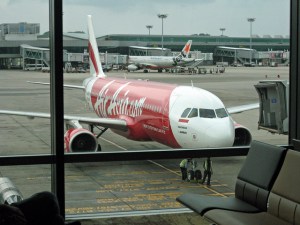
The photo below was taken at Changi Airport in Singapore before we left for the last leg of our trip. I noticed the AirAsia tagline on the plane’s livery, ‘Now Everyone Can Fly.’ For us, we were fortunate enough that the cost of the air travel really didn’t factor in as much into the planning of our trip. But I could see how this tagline would ring true for many people who previously wouldn’t be able to afford traveling internationally when the choices available were limited to the major international airlines.

Air Asia