Vietnam Veterans Memorial

The Vietnam Veterans Memorial is located at the National Mall area in Washington, DC, near the Lincoln Memorial. This memorial was created to remember the US armed forces service members who died in Vietnam/Southeast Asia and those who were Missing in Action during the War. The memorial was designed by architect Maya Lin, who won the design competition as a 21-year old Yale University student. The design was a source of controversy given its unconventional design. But over the time, people came to appreciate the beauty of its simplicity and emotional power of seeing the wall with names of those perished and missing.

I think the most moving part of this memorial is not only seeing the list of names of soldiers who perished during the War, but often times observing visitors coming to visit to look for a specific name of someone they know, and also seeing pictures, notes, letters, and other item left at the wall to remember someone.

The photo below was taken during a visit one weekend last summer. There were many people there, including a group of veterans, some in wheelchairs, coming to visit the memorial. There were also groups of young students who only learned about the Vietnam War from history books. As I saw one of the wall panels closely, I saw a reflection of the other side of the wall with visitors observing the wall, the Washington Monument and blue sky in the background, and an older gentleman observing the wall on the left corner, and the names etched on the wall. It made for a unique perspective to capture a scenery at this memorial.

Names on the wall at Vietnam Veterans Memorial

Lincoln Memorial

The Lincoln Memorial is located at the west end of the National Mall in Washington, DC. The memorial was dedicated in 1922 in honor of Abraham Lincoln, the 16th President of the United States. Lincoln served as the US President from 1861 to his assassination in 1865. He led the country through a very difficult time, the American Civil War, and credited with preserving the Union and for ending slavery. Lincoln has been consistently ranked as one of the greatest US presidents in the history.

The Lincoln Memorial itself over the years had become a special place in the US history as its steps had been the venue for many Civil Right Movement events. It was the place where in 1963 Martin Luther King Jr. gave his ‘I Have a Dream’ speech.

I’ve visited the Lincoln Memorial many times whenever I come to the National Mall, especially when taking out-of-town visitors. It’s a great place to visit both during the day and at night. The Lincoln statue is illuminated at night, and it’s open for visitors 24 hours a day, so sometimes late night is a good time to visit as there wouldn’t be as many visitors. I’ve also been there for an Easter sunrise service — it was quite a sight seeing the sunrise over the National Mall area from the steps of Lincoln Memorial.

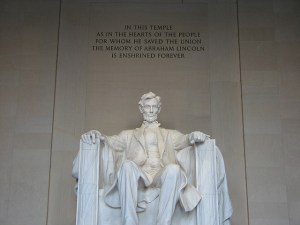
The photo below was taken during a day visit to the memorial. The whole Memorial building architecture was quite impressive, but even just looking at the Lincoln statue when thinking about what he had to go through to lead the country through such difficult times, gave me goose bumps.

Lincoln Memorial

National Mall

The National Mall in Washington, DC, is an open-area park right at the heart of city. This area is among the most popular places to visit in Washington, DC, particularly because there are many monuments located here and its proximity to landmarks like the White House, the US Capitol, and the Smithsonian Institute Museums. During the weekends (and summer evenings) this area is also popular among locals who go there to play sports, or simply go for a jog or a walk. On the west end of the National Mall you find the Lincoln Memorial. On the east end you find the US Capitol, and roughly in the middle you find the Washington Monument. It’s about 1.9 miles to go from one end to the other.

I live in the suburb of Washington, DC, so I don’t go to the downtown area on daily basis. But often times I would go there during the weekends especially either to visit one of the museums or if there is a special event (festivals, charity walks). The National Mall is pretty nice (and safe) to visit at night as well. You can see the Washington Monument and some of the memorials lighted up. During special days like Memorial Day or Fourth of July (or presidential inauguration), the whole area could be packed with people coming to attend concerts, fireworks, etc.

The photo below was taken from the steps of Lincoln Memorial. You can see the Reflection Pool, the Washington Monument, and the US Capitol in the distance.

National Mall

Gateway Arch

The Gateway Arch in downtown St. Louis, Missouri, is another very recognizable landmark in the United States. The Gateway Arch was built as part of the Jefferson National Expansion Memorial Park, which was established to commemorate Thomas Jefferson’s role in the Louisiana Purchase, which cleared the way for Lewis and Clark Expedition to explore the western part of what is now the United States. The Gateway Arch was designed by architect Eero Saarinen, who was also known for his design work on the Main Terminal at the Washington-Dulles International Airport, not far from where I live in Washington, DC, area.

I visited the Gateway Arch briefly during my coast-to-coast road trip with my brother tracing the historic Route 66 through St. Louis. We only visited the grounds of the Gateway Arch since we were under tight schedule for our trip. One activity that you could do if you visit the Gateway Arch with some time to spare is to take the elevator up inside the Arch. You can also visit the Museum of Westward Expansion to learn more about the history of land exploration in the Old West.

The photo below was taken from the grounds near the base of the Arch. Because of the size of the Arch, I had to take the photo in an angle to capture the whole Arch within the frame.

Gateway Arch

Mount Rushmore

In addition to the 58 national parks that were set aside to preserve the nature in the United States, there are also other properties managed by the National Park Service for other reasons, such as monuments or historical sites that are preserved to commemorate historical events or figures. In the next few days, I will add posts about some of these places that I’ve visited.

The first one to mention is a monument located within few hours from the Badlands National Park in South Dakota, Mount Rushmore National Memorial. This monument is a sculpture of four American presidents on a granite mountain — very recognizable monument, though given its location in South Dakota, unless you happen to pass the area during a road trip or you live in the state, chances are that you’ve never seen this monument in person. In fact, initially the idea of building this monument was to increase tourism to the state of South Dakota.

The four presidents represented on the monument — George Washington, Thomas Jefferson, Abraham Lincoln, and Theodore Roosevelt — were selected by sculptor Gutzon Borglum to represent the first 150 years of American history, and because of their role in preserving the Republic and expanding its territory. The figures were originally supposed to be carved head to waist, but it ended up to be only the heads due to insufficient funding.

I visited Mount Rushmore during a road trip from Rapid City to the Pine Ridge Indian Reservation. We only stopped briefly at the monument to take photos from a couple of different angles, but it was quite neat to see such a familiar monument in person.

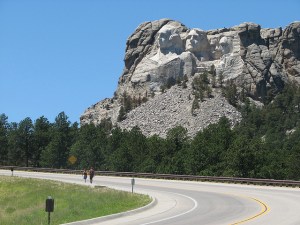
The photo below was taken at one of our stops near the monument. You can see the highway in front of the monument and a couple of visitors walking (to give you scale comparison for the size of the monument).

Mount Rushmore