Hotel with See-Through Bathrooms

One thing to note when planning a trip to Singapore is that the cost for accommodation is generally higher than other major Asian cities. So you want to budget accordingly, and/or select a place to stay that would fit with your budget and plans during your visit. During our short visit to Singapore, we stayed at a hotel called Aqueen Hotel located in the Lavender area of Singapore, north of the downtown / Central Business District area. We found this hotel on TripAdvisor; it generally had good reviews and the price was reasonable (comparable to the amount I would spend in staying at hotels in the United States). The hotel location is about 10-minute walk from the nearest MRT station. We did not try that however since our stay was too short and we ended up taking taxis instead. The hotel is on a major road, so it’s pretty easy to get a taxi.

Our first impression of the hotel when we arrived was pretty good. It looked pretty new, modern, and clean. Our room was on the fourth floor, and while the room was a little smaller than the other ones we stayed at during this trip, it was clean, well decorated, and looked very modern. There was one quirky interior design choice, however, that may make guests uncomfortable staying there. The bathroom had see-through glass walls, with the bottom part frosted but still somewhat see-through. We only stayed one night and didn’t use the bathroom that much during the stay, so it wasn’t that bothersome. Each of us just looked away from the bathroom when the other person was going to use it.

Overall it was a good stay for the one night we spent there. The bed was comfortable, and I didn’t hear noise from the road even though our room was facing the main road. In the morning they served breakfast at the restaurant at the ground floor of the hotel, though we didn’t try it as we opted to go for breakfast at a Hawker Center instead.

The photo below was taken in our room. You can see the bathroom with the see-through glass walls in the background.

Aqueen Hotel Lavender

Taxi Ride from Changi

Kristi and I arrived in Singapore after quite a long day traveling from Hanoi that started with spending several hours at the Hanoi Noi Bai Airport due to flight delay. Once we passed the immigration at Changi International Airport, we were ready to head to our hotel in Singapore. We decided to take a taxi ride instead of the MRT as we did not want to deal with walking around and looking for the hotel from the nearest MRT station.

During this trip, we had mixed experiences taking taxi ride in the countries we visited. In Bangkok, we took a taxi that was decorated with disco lights inside and the driver playing Lady Gaga music. In Hanoi, we had bad experience getting overcharged in a couple of rides and in another case getting yelled at for requesting a ride that the driver thought was too close to worth a ride. So I was hoping for a better experience this time in Singapore considering it’s generally an English-speaking country and things seemed to be more orderly and supposedly the taxi drivers were more honest.

We started the experience with waiting at the taxi line at the airport. It was quite a long line; there were probably about 50 people in front of us. I think we waited longer to get a taxi than getting through immigration that day. What made it even a worse experience was the hot and humid weather; we had to adjust back to that kind of weather after spending a week in the cool Northern Vietnam winter weather.

We finally got a taxi cab assigned to us. The driver was an older Chinese gentleman. The taxi car looked like somewhat older, but it was very clean and it was quite modern inside with the taxi meters inside. I told the driver the name and the address of the hotel. He nodded, and off we went.

The ride towards downtown Singapore was pretty smooth; not much traffic until we got close to the Central Business District. I took my camera out of my backpack and took some photos from the back seat. The driver recognized that it was my first visit to the city, so he pointed to some newer parts of the city like the Sands Marina Bay building in the distance.

We arrived at a hotel near downtown, but it didn’t look like the hotel that we were supposed to go to. When I showed the hotel name and the address again, the driver realized that he had taken us to the wrong location. He apologized and we continued our ride until we reached the correct location. When we arrived at the hotel, I was about to pay the driver what was shown on the taxi meter when the driver told us he apologized for taking us to the wrong location, and he refused to be paid full price because obviously the ride should have been shorter than it was. The price for the ride was not that expensive, so I told him it’s okay that he gave us a little sightseeing tour of downtown area Singapore, and I paid him the full amount.

I thought it’s interesting to think back that this could have been another bad experience riding a taxi. But given the honesty and attitude from the driver, I was okay paying extra amount for the unexpected longer ride, in comparison to felling ripped off when the taxi driver in Hanoi told us that he didn’t have change for our large bill and didn’t even attempt to look at his pocket to see if he had any.

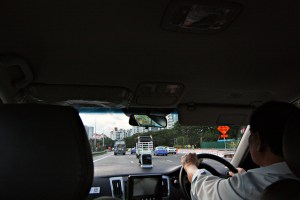
The photo below was taken from the back seat of the taxi cab as we’re getting closer to the Central Business District area of Singapore.

Taxi Ride in Singapore

One Night in Singapore

The last stop of our Southeast Asia trip was Singapore. We didn’t have much time left on our two-week trip, but we thought since Singapore was on the way home from Vietnam to Indonesia, we would at least include a stopover there.

For westerners coming to visit Southeast Asia for the first time, Singapore is often considered as the ‘Asia 101.’ The city is very modern and structured. Its airport, Changi International Airport, is considered as one of the main hubs in Asia, so you can easily find flights to Singapore from all over the world. You can get around with English easily, and the public transportation is very accessible in the small city-state area. Yet the influence from various cultures that make up Singapore population — Chinese, Malay, Arab, Indian — are still quite strong, so you can get a taste of those cultures during your visit in Singapore.

Given its close proximity to Indonesia, visiting Singapore is similar to Americans visiting the neighboring country of Canada. Many Indonesians would go to Singapore for short vacation. Some of my high school friends now even live and work in Singapore given the availability of job opportunities especially in high tech sector. For Indonesians, the two main attractions of Singapore are shopping and food. For Kristi and me, we didn’t care so much for the shopping part, but the food part definitely was the main draw.

Prior to this trip, I had only been to Singapore (if you could call it a ‘visit’) for few hours during a transit at Changi International Airport. So it’s pretty much all new to me. Kristi had been in Singapore several times before with family and friends. But she had not really spent time exploring the culture there before either. We only had less than one day to spend in Singapore (arriving in an afternoon, leaving again the following afternoon), so it had to be somewhat well-planned to make the best use of our time there.

We decided to use food as our ‘theme’ for the visit, so the goal was to try out several unique Singaporean dishes while we were there. As a guide, we decided to look at some Travel Channel programs covering Singapore: Anthony Bourdain’s No Reservations, Andrew Zimmern’s Bizarre Foods, and Samantha Brown’s Asia. We found information about some of the places these hosts visited, and decided to follow suit after seeing confirming good reviews about those places. Along the way, I also wanted to visit places that are uniquely Singapore like the downtown area, Raffles Hotel, Chinatown, and Little India. Quite ambitious for less than 24-hour visit, but we would give it a try.

The photo below was taken in an area in downtown Singapore called One Fullerton. You can see the iconic statue of Merlion, which is the mascot of Singapore.

Merlion

AirAsia

AirAsia is the pioneer of regional low-cost airlines in Asia. The Malaysian-based company started taking off as a popular air carrier in the region around 2001, and now it is the largest low-cost airlines in Asia. In addition to their main hub in Kuala Lumpur, AirAsia also has a couple of subsidiaries, Thai AirAsia based out of Bangkok, Thailand, and Indonesia AirAsia based out of Jakarta, Indonesia. They currently provide routes that cover 400 destinations in 25 countries.

My first exposure to AirAsia was during my Southeast Asia trip last year. We were planning on visiting several countries and traveling independently, so low-cost airlines came up as considerations for the travel. Most of the travel segments were pretty short distance (less than four hours), so we didn’t care as much about special in-flight service or extra-comfort (which would be more of a factor if we were traveling long distance). The primary factors considered were safety record, timeliness, and cost. Anyone traveling in Southeast Asia region with these factors considered would include AirAsia as an option. We looked at AirAsia routes for the travel itinerary that we’re planning, and found that it would work for two of the segments (Bangkok – Phnom Penh, and Singapore – Jakarta), but not for the other segments. Primarily because of the scheduling and routing — you get the low cost by traveling AirAsia but you’re paying in terms of longer travel times or inconvenient departure times (some of the routes would require us to transit in Kuala Lumpur in the middle, so a direct flight that would take only 3 hours may end up to be a more than 8 hour-trip). It’s pretty similar to what you find in the US with low-cost airlines like Southwest Airlines. Great service and great price, but at times may be inconvenient travel itinerary.

One interesting planning fact I learned from my cousin Kristi who had used AirAsia to visit several destinations in the region is that you can get ridiculously low fare if you can and are willing to book the flight way in advance (up to one year in advance). They would have limited seats that were deep discounted (more than 75% off), but with condition that you have to do advance purchase, and it’s not refundable/exchangeable. In some cases, the price was low enough that some people would go ahead and purchase the tickets even if it might mean they couldn’t use it and would have to waste it.

Another interesting tip to know is that the price is low because there are many things that are offered as ala-carte options to purchase (like extra luggage weight and in-flight food service). Today many US carriers impose extra luggage fee and charging for in-flight food service, and that received negative feedback from the customers. I guess that’s because people are used to having those services as part of what they’re expecting from air travel that taking those away (or charging extra for those) naturally would cause negative reactions. With AirAsia and other low-cost carriers, the low expectation is set upfront as a consequence of getting the airfare at lower price, so then their customers can opt to pay more to get the extra convenience (e.g., for us we paid a little extra for luggage weight allowance so we didn’t have to worry about getting too close to the standard limit and getting penalized for overweight).

The actual travels on AirAsia were actually quite uneventful. It was interesting to observe that when we checked in, instead of given the boarding pass in the typical ticket-size print outs, ours looked more like a grocery/store receipts. I guess either way it has barcode so it doesn’t really matter — and they don’t have to get specialized printers to print those.

Both our Bangkok – Phnom Penh and Singapore – Jakarta trips left and arrived on-time. The flights were quite normal and somewhat like a typical flight experience for frequent flyers — courteous flight attendants who at a couple of occasions walked the aisle to offer in-flight food service for purchase (we were not allowed to bring our own food items to the flight). There were no in-flight entertainments, though for the short flights, this didn’t really matter.

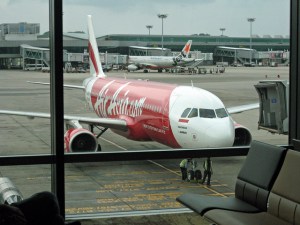
The photo below was taken at Changi Airport in Singapore before we left for the last leg of our trip. I noticed the AirAsia tagline on the plane’s livery, ‘Now Everyone Can Fly.’ For us, we were fortunate enough that the cost of the air travel really didn’t factor in as much into the planning of our trip. But I could see how this tagline would ring true for many people who previously wouldn’t be able to afford traveling internationally when the choices available were limited to the major international airlines.

Air Asia

Southeast Asia

I spent this New Year at home — a low key one. But to start the new year for this blog, I thought I would begin with a series of posts based on my trip last year around the New Year’s Day to several Southeast Asian countries.

This trip started initially with an idea to go to Australia to visit my cousin who was studying in Melbourne. I was planning on going home to Indonesia, and I thought it would be nice to piggy back on that trip with ‘a trip within the trip’ to go somewhere near Indonesia. Well, the Australia trip ended up not working out, so I had to look for an alternative. The timing was at the end of December and beginning of January, as that was the time that would work best for my cousin Kristi who would be my traveling partner. We looked at several ideas: New Zealand (too expensive), China (too cold), and Japan (both too expensive and cold). Then we started thinking about where we would like to celebrate the New Year’s Day to make it memorable (with the original Australia trip, we were thinking about being in Sydney for the end of the year). One place came up to mind: Angkor Wat in Cambodia. Neither of us had been to Cambodia, it’s close to Indonesia, it’s relatively cheaper to travel there, and the weather should be pretty good at the end of December.

So that was the ‘anchor’ for the plan — New Year’s Day at Angkor Wat. Then we started building an itinerary around it. We thought of going for two weeks, so we started thinking about places in Cambodia and nearby countries that we would like to visit and the one that Kristi had not been before. I had never been to any of these countries, so any place we pick would be new to me.

Finally we settled on the following itinerary: starting with a couple of days in Bangkok, Thailand, then continued to Cambodia with visits to Phnom Penh and Siem Reap (timed to be in Siem Reap for the New Year’s Day), then continued to Northern Vietnam with visits to the capital city of Hanoi, the mountain region of Sapa, and the famous Ha Long Bay, and finally ending with short stop in Singapore. So this series of posts will follow this trip and I will highlight places we visited and some unique travel experience from this trip.

The photo below was taken on the New Year’s Day at Angkor Wat near Siem Reap, Cambodia. We decided to skip the New Year’s Eve celebration and went to bed early so we could get up early in the morning and experience the first sunrise of 2011 at Angkor Wat. So there it was… the most memorable New Year’s Day morning in my life to date.

First sunrise of the year