Bibimbap and bulgogi

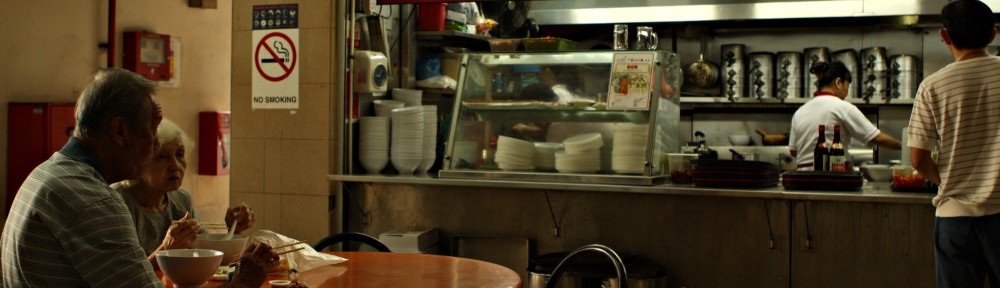
The last stop on the Seoul City Tour before we headed back to the Incheon International Airport was lunch at a local restaurant. I did not know the name of the restaurant as the sign was written in Korean, but it’s pretty clear from the picture outside the restaurant that they had beef dishes.

At the beginning of our tour, the tour guide explained that we could pick from two options for lunch; each person could get either bulgogi (grilled beef dish) or bibimbap (mixed vegetables over rice). I had had both of these dishes before, so I just picked the bibimbap. Some of folks in our tour group had never had either of these Korean dishes before, so they had to decide after listening to our tour guide’s description and looking at photos of the dishes.

When we entered the restaurant, we were seated at a couple of long tables in one corner of the dining area. The restaurant was pretty small, and it was actually quite packed with locals for lunch. I thought that’s good to see the locals also eating at the restaurant; that means they’re not catering only to foreigners/tourists, and the food should be quite authentic.

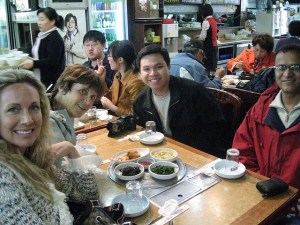
I sat together with three new friends that I made during this tour. Wendy was from Los Angeles, CA, and she was on the way back home after visiting Thailand and Indonesia. Susan was from Philadelphia, PA, area, and she was on the way home after visiting Laos and Cambodia. Rajan was from Houston, TX, and he was on the way to Malaysia and Indonesia for business trip. My brother lived in Los Angeles area at that time, and I had worked on projects in both Philadelphia and Houston, so I was able to relate with all of these travelers. It was pretty cool listening to Susan and Wendy talked about their experiences during this trip (pretty neat hearing about my home country, Indonesia, from the perspective of a visitor like Wendy), and I was able to give recommendations to Rajan on possible places to visit during his upcoming visit to Jakarta.

The meal itself was pretty good. This was the first time for these other travelers trying Korean food, so it was great to see them first getting surprised seeing the various side dishes served with a meal at a Korean restaurant, and then enjoying the dishes for the first time. My bibimbap was pretty good — similar to what I had before in the United States.

After lunch, we headed back to the airport to end the tour. We had to go through slow-moving traffic, so our tour guide was a little concerned that some of us might miss our flight. She asked for everyone’s scheduled departure time, and we found out that I had the earliest departure time compared to others. We ended up arriving at the airport about 35 minutes later than expected, but fortunately it was still enough time for me to go through the security gate and walked to the departure gate. I got there with about 10 minutes to spare til the boarding time for my connecting flight.

That ended the 22-hour stop in South Korea during my trip from Washington, DC, to Jakarta, Indonesia. I wasn’t expecting it to be full of adventure, but I’m glad I was able to get a glimpse of South Korea during that brief stop. If you ever have to stop in transit at Incheon International Airport, I highly recommend making the most out of your stop by taking the transit tour.

The photo below was taken at the restaurant while we were waiting for our food. You could see me with my three new friends, Wendy, Susan, and Rajan, and around us were the locals either their lunch in a busy restaurant.
Lunch in Seoul

Cheonggyecheon

After a brief stroll on the main street of Insa-dong, we hopped on our Seoul City Tour bus to go to the last sightseeing stop of the tour, Cheonggyecheon. Cheonggyecheon is an 8.4 km-long, modern public recreation space in downtown Seoul. This was an urban renewal project that changed an eyesore scenery in the city into a beautiful public park with nice landscaping.

We only had few minutes to take a look at part of Cheonggyecheon. It was quite nice to see the park among the highrise buildings, and hear the sound of water flowing from the stream. There was a walking path along the stream, and the wall along the side of the path was decorated with murals that depicted scenes from Korean history.

The photo below was taken from the steps down to the walking path from one of the streets that cross over the stream. You can see some of the landscaping done on the stream. It seems to be a nice place to stroll and retreat momentarily from the hustle and bustle of the city. I think for photographers coming to the city, this might be one of those nice urban places for shooting photographs.

Cheonggyecheon

Insa-dong

After visiting the Gyeongbokgung Palace and the National Folk Museum, we continued our Seoul City Tour to a nearby district called Insa-dong. Insa-dong is a neighborhood in Seoul that is full of stores selling arts and crafts, antiques, and all kinds of collectibles. It is a destination for the locals and tourists alike.

Our tour bus dropped us at one end of the main road in Insa-dong. Our tour guide said that we had about half an hour to walk through the street to check out the stores. The bus would pick us up at the other end, about 1 km or so. Most of us went in groups to make sure that we didn’t get lost. It’s actually also kind of fun to go with other tourists that we met in this tour, as some were looking for items to purchase to add to their collections of items from around the world at their homes. I was not planning on purchasing anything, but I did have some cash in both Korean won and US dollars. In a couple of weeks after this trip, I was going to attend a Christmas party that included a white elephant gift exchange, so I thought I could find something interesting to take home as a gift. At one store, I found a great gift – a hand-drawn landscape picture on paper with some calligraphy. And the price fit within the maximum budget allowed for the gift exchange.

The photo below was taken in front of one of the stores on the main street of Insa-dong. The kittens looked so realistic; you could easily mistake them for the real ones.

Kittens at Insa-dong

National Folk Museum

After walking the grounds of the Gyeongbokgung Palace, our Seoul City Tour group continued with a visit to the National Folk Museum of Korea. The museum is located right next door from the Gyeongbokgung Palace. The museum has artifacts that illustrate the history and traditional life in Korea. It reminded me somewhat to the American History Museum in Washington, DC.

Our visit to this museum was quite brief. I did see artifacts like traditional clothes, musical instruments, games, etc. and also some depiction of traditional practices within the Korean culture. But similar to other museums, you would be able to get more out of the visit if you’re willing to spend more time to really go through the exhibits.

The photo below was taken outside the museum. I noticed this group of Korean schoolboys in their uniform. It looked like they’re enjoying their visit to the museum, though I’m not sure at their age if they really appreciated what they saw at the museum. It reminded me to my own experience visiting museums in school trips when I was young; I was more excited about missing classes and going on the trip with my friends than about learning from the visit to these places. I guess it’s probably the same in any culture or country; you could see similar scene at the National Mall in Washington, DC, or at the National Museum in Indonesia.

Schoolboys at the National Folk Museum

Gyeongbokgung Palace

The first place we visited during the Seoul City Tour was the Gyeongbokgung Palace. The palace is located in the northern part of Seoul. It was first constructed in the 14th century and reconstructed in the 19th century, and it was once the residence of the royal family. The palace complex was nearly destroyed by the Japanese in the early 20th century; the buildings are slowly being restored and as of 2009 nearly 40 percent of the original palace buildings still stood or had been reconstructed.

During my visit to the palace, we first saw the changing of the guard ceremony at the Gwanghwamun, the main entrance to the palace. After entering the palace, we spent time touring around and visited many buildings that made up the palace. Our tour guide provided us with some explanations of the functions of the various buildings inside the palace.

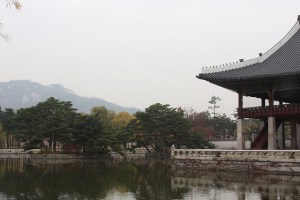
The building in the photo below is the Gyeonghoeru Pavilion. It is the Royal Banquet Hall that with a pond and landscaping around looked quite nice especially in the autumn.

Gyeonghoeru Pavilion