Ecotourism

When we visited the village of Cat Cat near Sapa, Vietnam, I couldn’t help of thinking about the concept of ecotourism and how it seemed to be applied there. Compared to the other villages we visited the day before, Cat Cat clearly had been developed to be more tourist friendly with the nice walking path down into the valley and back up, complete with maps along the way, and during the busy tourist season, even some planned cultural events, demonstration, etc. There was fee collected on the way to the village, and ticket is needed to enter the village by foreigners. It was quite organized that in the beginning I wasn’t sure whether we’re entering a real village or a theme park.

Since we came during an ‘off day’, there were not many visitors around, and while there were a couple of souvenir shops open along the trek, clearly they were not anticipating big crowd that day. As we walked through the heart of the village, we passed the homes of the locals that looked like real homes in the village. While the path through the village might be developed to make it more comfortable and aesthetically pleasing for the visitors, the buildings in the village seemed to be the local homes without much modification. And as we passed some of the homes, we could see the locals going about their lives normally — nothing was staged. Nothing exciting too see or much of ‘photo op’ along the way, but I thought this was a more authentic atmosphere to portray to outsiders who wanted to know how the locals live.

That reminded me back to the concept of ecotourism. In the last couple of decades, there has been a lot of emphasis on this concept especially as the increased globalization opened up many new destinations around the world that are rich culturally but previously were not well known as travel destinations. One definition of ecotourism is as follows: ‘Ecotourism a form of tourism involving visiting fragile, pristine, and relatively undisturbed natural areas, intended as a low-impact and often small scale alternative to standard commercial (mass) tourism. Its purpose may be to educate the traveller, to provide funds for ecological conservation, to directly benefit the economic development and political empowerment of local communities, or to foster respect for different cultures and for human rights.’ You can see from this definition how it could be a really good thing if done correctly as it would benefit the locals while at the same time preserving the environment and culture for future generations. However, in reality, this could be quite difficult to accomplish, as some of the goals may be at odds with each other when implemented (e.g., trying to benefit local economy vs. minimizing negative impact from the outside world). And sadly some government or travel operators used the ecotourism idea to promote their business while in reality they didn’t really do what’s needed to meet the goals of this type of tourism.

One other interesting observation I heard once on a travel program was about the impact of global economy on the local culture, and how the local culture itself is evolving because of that. The case in point used during the discussion was Ireland, where in the early 2000s there was a big economic boom that the country attracted immigrants from Eastern Europe and some European Union countries. As a result, the local culture had become more diversified. This became an unexpected surprise for tourists who came to Ireland with the expectation of experiencing the authentic, perhaps romanticized Irish culture. When they could actually find those, often times it would be staged as show only for tourists, and gone was the authentic culture to observe.

I wonder how long before such effect would impact places like Sapa. The draw of economic benefits I think would be much stronger than simply preserving the old way of life. We already saw during the trek the day before how some local minorities became very dependent on the tourism business and introduced a new pattern of behavior that didn’t necessarily exist prior to the increase of tourism in the region — following (bordering stalking) tourists to get them to buy handicrafts or souvenirs. For tourists, I think a good place to start is to consider activities or using operators who have good reputation of benefiting the locals and also having the minimum impact possible to the environment, and keep this in mind as you visit, learn, and appreciate the local culture, people, and environment that you visit.

The photo below was taken as we walked through the village. You can see the local homes on the side flanking a nicely path walkway through the village. On the left you see a small store selling some souvenirs. On the right is a normal home that was ‘normal’ and not staged for tourists at all. You see Kristi walking on the path, with one of the local girls jumping around like a ‘mountain goat’ (as May, our local tour guide from the day before, said).

Through the Cat Cat village

Simpler (or Different) Life

When we were descending through the paved pathways towards the village of Cat Cat near Sapa, Vietnam, several times we were passed by locals who were able to navigate through the steps on the paths faster than us. A couple of time we were passed by some children who seemed to live in the village.

As I remembered observing those children, I couldn’t help to think if they live a simpler, or at least different, lives than their counterparts in big cities. I didn’t know how much the incoming tourism industry introduced the western culture to them, but looking at some children playing in the backyard, or simply just walking with their friends through their village, seemed to be a timeless part of life in any culture that sadly in the modern age today has been replaced with television, video games, and other more individualistic and less active activities. I thought it’s also interesting that those in more ‘modern’ world would romanticize life in the countryside through TV programs like Little House on the Prairie or Anne of Green Gables — this was the association that came to my mind when I saw the local girls passing by seemingly care free and didn’t pay much attention to the tourists like us whom they passed on the path ways. I suppose we tend to look at life that is different than ours as potentially something better, if anything, to take our minds away from our current world momentarily.

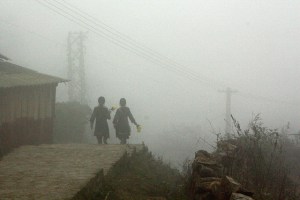
The photo below was taken during the walk. You can see a couple of girls walking through the path enjoying each other’s company and carrying flowers in their hands.

Friends

Domesticated Animals

As we walked down the path to the village of Cat Cat near Sapa, Vietnam, we passed many homes and shops where the locals had domesticated animals around, ranging from dogs to ducks, chickens, and pigs. As I remembered our encounters with these animals during our trek (some we met quite literally on the walking path as they freely roamed around their neighborhood), I couldn’t help to think of the difference between these domesticated animals and the ones you now see in big cities / urban areas especially in the western world.

If we observed the domesticated animals we saw in the villages of Sapa, you could likely guess the reasons why these animals were there. Usually they serve a certain function, whether as a guardian, as a helper for work, or as potential meat source. This is probably the same way in most places around the world, at least traditionally.

In big cities and more affluent societies, today you see more and more people having domesticated animals as pets. In some places, having pet is almost equivalent or (some people perhaps even consider them as a replacement of) to having a child. Pets are given treatment that are more costly than what’s given to a human being, and people would argue for more ‘humane’ way of treating animals. I suppose when you have the luxury and options to choose what you want you can do this. I doubt in small, remote villages people would think much about the animal rights or spending extra cash to treat their domesticated animals.

I remembered back when I was little in Indonesia we had a dog that we got from a neighbor and functioned as both a pet and guard dog. We didn’t do anything to abuse the dog or treat it in ‘inhumane’ way, but it didn’t get any special treatment either — the dog would eat leftovers of whatever we ate — nothing specially made or purchased to feed it.

The photo below was taken by Kristi as I saw a couple of piglets on the walking path and I tried to get closer to them to take photos. They ended up running away before I was able to take closer snapshot of them.

Chasing piglets

Sleepy Village

After reaching the entrance to the pathway to the Cat Cat village near Sapa, Vietnam, we showed our entrance tickets to the gentleman at the entrance booth, and off we went to explore the village through the well-paved and marked path to visit the village.

We walked down through the path following illustrated maps that were posted every several hundred feet or so. This village particularly had done a good job in setting up the village path so it’s easy for foreigners to navigate.

As we walked down the path, we passed a couple of souvenir shops on the side of the path that were set up, but weren’t seeing much traffic that day. One of them didn’t even have anyone manning the shop, only a dog that was sleeping near the merchandise.

It seemed like a very slow, and perhaps boring life there. But now, looking back from a very hectic life in big city, being in such a slow-paced place sounds great to me. I wish I could just be like that dog sleeping in a peaceful, quiet setting and not caring about anything.

The photo below showed the dog sleeping near the souvenirs — completely oblivious of anything going on around.

Sleepy Village

Peaceful Trek

During the walk down the road from the town of Sapa, Vietnam, to the village of Cat Cat, we discovered another aspect of visiting ‘off the beaten path’ destinations on our own: being able to experience and enjoy the slower pace of life and the peaceful atmosphere.

Since Kristi and I went on our own, we didn’t have the ‘entourage’ of local women going with us to sell souvenirs. We pretty much walked alone, and once in a while we passed locals either on foot or on motorcycles (which seemed to be the preferred ‘public transport’ locally). But to the most part we could just walk and simply got ‘lost’ in the village environment.

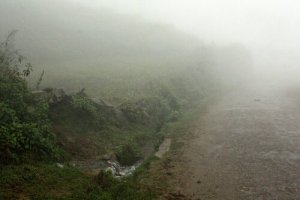
When there was no other ‘noise pollution’ or visual stimulus that compete for your attention, you start noticing little things. For me, it was the gentle sound of water streaming down on the side of the road, as seen in the photo below. The foggy day added another interesting dimension to the sense of place. I think this is why people came to this area back in the French colonial days — to get away from the hustle and bustle of the city and to slow down and rest.

Peaceful Trek